 EN
EN

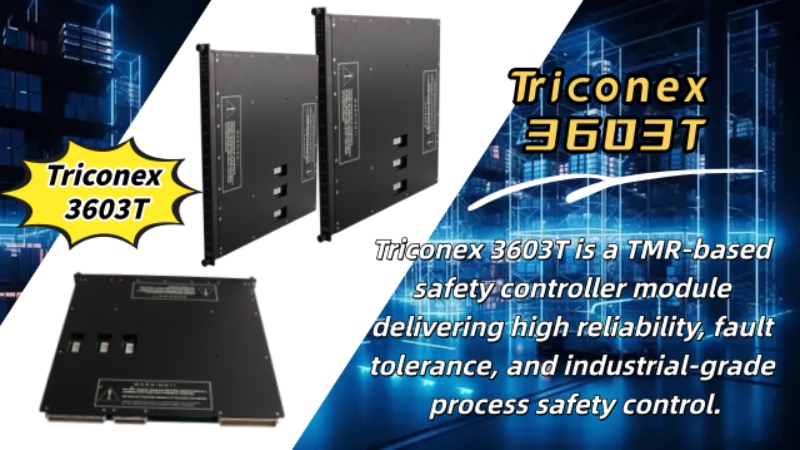
In high-risk industrial scenarios such as petrochemicals, power generation, and rail transportation, Safety Instrumented Systems (SIS) play the role of the last line of defense. Once the control system fails, the consequences often include equipment damage and even personal injury. Therefore, a high-reliability architecture has become one of the core objectives of industrial control system design.
Schneider Electric's Triconex series of safety control systems have long been used in critical industrial fields, with the Triconex 3603T module being a representative of the industry due to its typical TMR (Triple Modular Redundancy) architecture. This article will provide an in-depth analysis of its architectural principles and safety mechanisms.
Basic Principles of Triconex 3603T and TMR Architecture
The Triconex 3603T is the core processing module in the Tricon safety control system. Its design is based on the TMR (Triple Modular Redundancy) concept, which achieves system-level fault tolerance by having three completely independent but logically consistent control units simultaneously run the same control task.
The three controllers independently perform input acquisition, logic operations, and output control, exchanging data in real time via high-speed internal communication. The system ultimately uses a majority voting mechanism (2oo3 Voting) to determine consistency. If all three are consistent, a normal control signal is output; if a single point of deviation occurs, abnormal results are automatically eliminated, preventing erroneous signals from entering the execution layer. This mechanism essentially trades spatial redundancy for reliability, enabling the system to maintain safe operation even with a single point of failure.
3603T Hardware Redundancy Design: Eliminating Single Points of Failure at the Physical Layer
At the hardware level, the Triconex 3603T employs a completely independent three-channel architecture. Each channel contains an independent CPU processing unit, memory, power input, and clock system. This means that failure of any single hardware component will not affect the normal operation of other channels.
The system also uses a triple-isolation backplane design, physically isolating the three data channels completely, structurally preventing electrical interference or fault propagation. Meanwhile, this module supports online hot-swappable maintenance, allowing engineers to replace faulty modules while the system is running and restore data consistency through an automatic synchronization mechanism, thereby minimizing system downtime.
This hardware-level redundancy design enables the system to maintain stable operation even under complex electromagnetic environments and high load conditions in industrial settings.
TMR Software Synchronization Mechanism: Ensuring Three-Channel Logic Consistency
At the software level, although the three processing units operate independently, they must maintain strict synchronization. The Triconex 3603T ensures that all logic executes within the same time window through a unified scan cycle mechanism and guarantees that all three channels use completely consistent field data based on input data snapshot technology. At the end of each control cycle, the system compares the calculation results of the three channels item by item, including input variables, intermediate logic states, and final output values. If a channel is found to deviate significantly from other channels, that channel will be automatically marked as abnormal and removed from the voting logic.
Furthermore, the system employs a deterministic scheduling mechanism, making the execution time of each task fixed and predictable, fundamentally avoiding the time drift problem common in real-time control systems. This strict synchronization mechanism is a crucial foundation for achieving high-level safety certification.
2oo3 Voting Mechanism: The Core Balance Between Security and Availability
The core of the TMR architecture lies in the 2oo3 (Two out of Three) voting logic, which achieves a delicate balance between security and system availability.
At the input layer, signals such as pressure, temperature, or flow are independently acquired in three channels. When inconsistencies occur among the three channels, the system automatically identifies and eliminates outliers. For example, if two signals are close while the third deviates significantly, that outlier channel will not participate in subsequent control calculations.
At the output layer, three controllers calculate the execution results separately. For example, in the case of an Emergency Stop System (ESD) action signal, the final control command is only output when at least two signals are consistent, thus avoiding malfunctions or single-point-of-failure triggers.
This mechanism allows the system to maintain full functionality even if one channel fails, while automatically entering a safe state when multiple channels are abnormal, achieving the industrial safety goal of "neither stopping the system nor losing control."
Security Enhancement Mechanisms in Industrial Applications
In addition to the TMR architecture itself, the Triconex 3603T integrates multi-layered security enhancement designs to adapt to complex industrial environments. The system features comprehensive self-diagnostic capabilities, enabling real-time monitoring of CPU load, memory status, communication links, and input signal quality. Upon detecting anomalies, it can quickly locate and isolate faulty channels.
Simultaneously, adhering to a safety-first principle (Fail-safe), the system automatically enters preset safety states when a reliable judgment cannot be made, such as closing valves or triggering an emergency shutdown to prevent escalation of risks.
Furthermore, the system's hardware design enhances its resistance to electromagnetic interference. Through signal isolation, shielding structures, and filtering technologies, it reduces the impact of high-noise industrial environments on the control system, enabling stable operation in highly interference-prone scenarios such as high-voltage motors and frequency converters.
Conclusion: The Core Value of TMR Architecture in Industrial Safety
The TMR architecture represented by the Triconex 3603T is essentially an engineering philosophy that achieves high reliability through system redundancy. Its triple independent channel design effectively eliminates the risk of single points of failure, enabling the system to maintain safe operation even if some components fail. The 2oo3 voting mechanism strikes a balance between safety and availability, avoiding the traditional system's "either down or unsafe" dilemma. Furthermore, combined with comprehensive diagnostics and fail-safe mechanisms, the system meets IEC 61508 SIL3 and even higher industrial safety standards.
This architecture is not only a mature solution for industrial control technology but also represents the engineering pursuit of "deterministic safety" in high-risk industries, and will continue to hold an important position in the future development of intelligent manufacturing and industrial automation.
If you have any questions about the product, please contact us
Sales manager:Jim Pei
Wechat: ZXH18020776782
Table of Contents
- Basic Principles of Triconex 3603T and TMR Architecture
- 3603T Hardware Redundancy Design: Eliminating Single Points of Failure at the Physical Layer
- TMR Software Synchronization Mechanism: Ensuring Three-Channel Logic Consistency
- 2oo3 Voting Mechanism: The Core Balance Between Security and Availability
- Security Enhancement Mechanisms in Industrial Applications
- Conclusion: The Core Value of TMR Architecture in Industrial Safety