 EN
EN

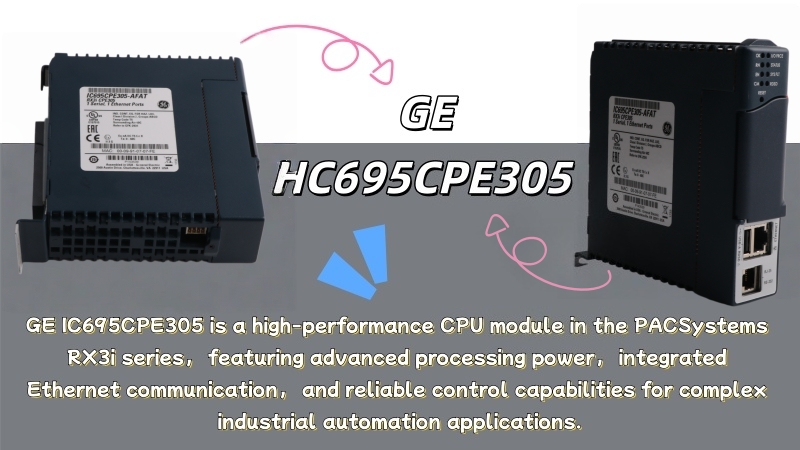
In the industrial automation spare parts industry, what truly defines a professional is not merely familiarity with brands and model numbers, but the ability to quickly understand a controller’s system role and translate it into a deployable on-site solution. The GE RX3i series IC695CPE305 is a typical example of such a device. It is not only the CPU core of a control system, but also the “decision-making brain” of the entire automation architecture. This article moves from model decoding to hardware capabilities, spare parts value assessment, Modbus TCP practice, and field experience, systematically explaining how this model operates in real industrial scenarios.
IC695CPE305 Model Number Breakdown
In industrial spare parts selection and replacement, “understanding the model number” is often more important than simply reading specifications.The IC695CPE305 can be broken down as follows:
IC695: Indicates the GE RX3i PACSystems platform, a new-generation programmable automation control system series
CPE: Central Processing Engine, meaning the central processing unit (CPU)
305: A performance level and version identifier, typically reflecting differences in processing power, memory configuration, and communication capability
From a spare parts perspective, this means:
It is not a simple I/O module, but the core CPU unit of the entire control system, responsible for logic execution, communication management, and system coordination.
In real-world applications, the IC695CPE305 is commonly used in medium-to-large automation systems, such as:
Automotive manufacturing production lines
Water treatment control systems
Energy management systems
Process control systems (DCS/SCADA subsystems)
Hardware Capability and System Positioning
From a practical engineering standpoint, the IC695CPE305’s main strength lies in its relatively high processing performance. Compared with earlier PLC controllers, it offers significantly improved logic scan speed and floating-point computation capability, enabling it to handle more complex control algorithms such as multi-loop PID regulation, process interlocking logic, and multi-variable control strategies.
In terms of communication, this CPU natively supports industrial Ethernet architecture and can implement protocols such as Modbus TCP/IP and SRTP through system expansion. It can also integrate more advanced industrial networks like EtherNet/IP via Ethernet modules. This multi-protocol compatibility gives it strong adaptability in heterogeneous system integration scenarios.
Structurally, the IC695 platform uses a modular backplane design, where the CPU acts as the central node communicating with I/O and communication modules via a backplane bus. This design not only improves system scalability but also simplifies maintenance and spare parts replacement, making it highly valuable in long-term industrial operations.
Spare Parts Engineering Value Assessment
From a spare parts engineer’s perspective, evaluating the IC695CPE305 goes beyond simply asking whether it can be replaced. It requires a comprehensive judgment across replacement risk, lifecycle status, and system dependency.
In terms of replacement compatibility, the model can often be substituted within the same platform family, for example with other CPE models in the same series. However, firmware version consistency and project file alignment must be strictly verified; otherwise, issues such as program download failure, communication errors, or variable structure mismatch may occur, which is especially critical in downtime recovery scenarios.
From a lifecycle perspective, this series has already entered a later maintenance stage in some regions. As a result, it shows a strong spare parts-driven market trend, especially in legacy factories and long-running installations where dependency on this CPU remains high. This also contributes to stable demand in secondary spare parts markets.
At the system dependency level, the IC695CPE305 is often tightly coupled with existing project files, network configurations, and upper-level systems. When hardware failure occurs, replacement is not just a physical swap; it also involves IP configuration, protocol consistency, and program restoration. Therefore, spare parts strategies must be planned in advance rather than treated as reactive maintenance.
Practical Modbus TCP Applications in IC695CPE305
In industrial Ethernet communication, Modbus TCP is one of the most mature and widely used protocols. In real projects, the IC695CPE305 can function either as a master or a slave device, offering strong flexibility in system integration.
In a typical architecture, the CPU sits at the core of the control layer, connected through industrial switches to remote I/O modules, smart instruments, and variable frequency drives. The network is usually designed in a star topology or redundant ring structure to ensure stability and reliability.
During engineering configuration, the key focus is IP address planning and communication parameter consistency. The PLC must be configured within the same subnet as field devices, with correct settings for port 502, station identifiers, and register mapping relationships. At the variable management level, internal PLC variables must be properly bound to Modbus registers to ensure accurate data exchange between control logic and upper-level systems.
From a data model perspective, Modbus objects such as coils, discrete inputs, input registers, and holding registers must be managed through variable or symbol tables inside the PLC. A well-designed mapping structure directly impacts communication efficiency and data consistency across the system.
Field Debugging and Practical Experience
In real-world commissioning, the most common issues involving IC695CPE305 in Modbus TCP applications typically fall into three categories: communication linkage, data refresh, and network stability.
Communication failures are rarely caused by a single factor. They often originate from layered issues starting at the physical network level and extending to the protocol layer. Engineers typically begin troubleshooting by checking physical connectivity such as cable status and switch indicators, then perform a ping test to verify IP reachability, and finally inspect port and protocol configuration. If the network layer is not functioning, correct PLC configuration alone cannot establish communication.
Issues such as data not updating or response delays are usually related to scan cycle design and communication load. In complex systems, reading too many registers at once increases CPU communication burden, slowing down overall system response. Optimization typically involves segmented polling or data caching strategies to reduce network and CPU load, along with adjusting PLC scan cycle parameters to better align control logic and communication timing.
Dropouts and reconnection issues are also common in industrial environments, especially in areas with strong electromagnetic interference or complex network structures. These problems are often linked to cabling quality, grounding design, and switch industrial ratings. Therefore, industrial-grade switches, shielded twisted-pair cables, and proper grounding practices are commonly used to enhance overall communication stability.
System-Level Thinking: From Controller to Control Core
The true value of the IC695CPE305 is not limited to its hardware itself, but lies in its role as a central hub in the automation system. It handles not only logic execution, but also communication management, data scheduling, and process algorithm execution, serving as a critical bridge between field devices and upper-level SCADA systems.
In modern industrial automation, as systems continue evolving toward networking and digitalization, controllers like the IC695CPE305 are no longer simple execution units. Instead, they have become system-level decision and information exchange centers. Understanding their operational logic essentially means understanding how the entire industrial control system operates.
Conclusion
For engineers engaged in automation spare parts and system integration, the IC695CPE305 is more than just a product model—it is a condensed representation of an entire industrial control ecosystem. From model decoding to communication protocol implementation, from field debugging to spare parts strategy, each layer directly impacts system stability and project delivery quality. In an increasingly complex industrial environment, mastering the engineering logic behind such core controllers is equivalent to gaining the capability to deliver reliable and scalable industrial systems.
If you have any questions about our products, welcome to contact us
Sales manager:Jim Pei
Wechat: ZXH18020776782