 EN
EN

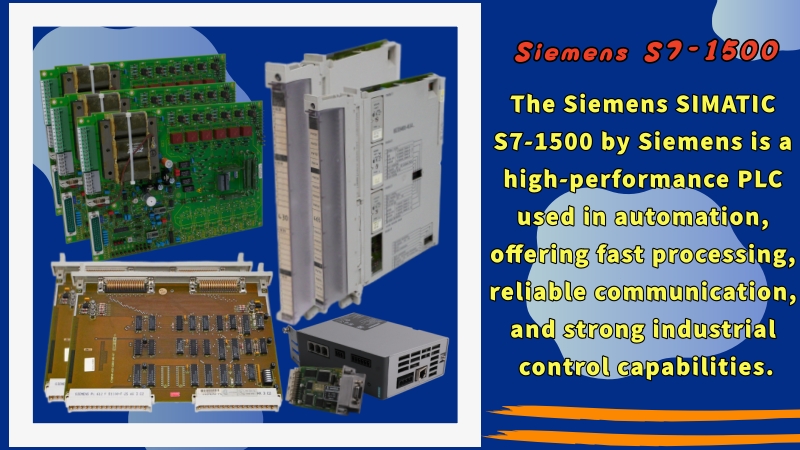
With the rapid development of industrial automation and smart manufacturing, PLC control systems are playing an increasingly important role in modern industry. As Siemens' new generation of high-performance controllers, the S7-1500 PLC has become the core control platform in numerous industrial automation projects, thanks to its high-speed processing capabilities, robust communication performance, and flexible scalability. Compared to traditional PLCs, the S7-1500 not only meets complex equipment control requirements but also adapts to the trends of Industry 4.0 and digitalized factories. This article will provide a detailed introduction to the product features of the S7-1500, CPU selection, module configuration, TIA Portal engineering applications, and typical industry applications, helping users gain a more comprehensive understanding of the practical application value of this series of PLCs.
Overview of Siemens S7-1500 PLC Series
Siemens S7-1500 is a PLC product launched for the mid to high end automation control field, mainly used for production line control, complex equipment control, and intelligent manufacturing systems. This series has significant improvements in processing speed, system stability, and network communication capabilities compared to traditional PLCs such as S7-300, while also having more comprehensive diagnostic and debugging functions.
Siemens S7-1500 adopts a modular structure design, allowing users to flexibly expand digital modules, analog modules, and various communication modules according to project requirements, thereby meeting the application needs of automation systems of different scales. The CPU itself integrates PROFINET interface, which facilitates industrial network communication and device interconnection.
In addition, S7-1500 also supports motion control, security control, OPC UA and other industrial Internet functions, so it is widely used in automobile manufacturing, packaging machinery, logistics transportation, water treatment, lithium battery equipment and other industries.
With the advancement of industrial digital upgrading, S7-1500 is no longer just a PLC control system, but has gradually become the core data control platform in smart factories.
How to choose the appropriate S7-1500 CPU
In the process of PLC system design, the selection of CPU directly affects the operational efficiency and later expansion capability of the entire system. Different models of S7-1500 CPUs have differences in processing performance, memory capacity, and communication capabilities, so it is necessary to make reasonable choices based on actual project requirements.
For small devices with fewer I/O points, CPU1511 or CPU1512 can usually be chosen, which can meet general logic control and device interlocking requirements. If the project involves a large I/O scale, complex data processing, or multi device linkage control, it is more suitable to choose high-performance models such as CPU1513, CPU1515, or even CPU1516. For large-scale automated production lines or systems with large amounts of data, it is also necessary to consider the program processing capacity and communication load capacity of the CPU to ensure stable system operation.
In addition to basic control requirements, communication functionality is also an important reference factor for selection. Modern industrial systems typically require communication with HMI, SCADA, MES, robots, and third-party devices, so it is necessary to confirm whether the CPU supports communication protocols such as PROFINET, PROFIBUS, OPC UA, or Modbus TCP. If the system involves motion control or safety control, CPU models that support Technology or Fail safe functions should also be selected to meet high-precision motion control and industrial safety control requirements.
Reasonable CPU selection can not only reduce project costs, but also reserve sufficient space for later system expansion.
S7-1500 Common Modules and Communication Options
The modular structure of S7-1500 is one of its important advantages. Users can freely combine different functional modules according to the type of on-site equipment and control requirements, in order to build an automation system that is suitable for project needs.
The digital quantity module is mainly used to collect on-site switch signals, such as button, proximity switch, and sensor status, and can also be used to control execution devices such as relays, solenoid valves, and contactors. The analog module is mainly used to process industrial signals with continuous changes in temperature, pressure, flow rate, and liquid level, and is widely used in process control systems.
In addition to I/O modules, communication modules are also an important component of industrial automation systems. By expanding the communication module, S7-1500 can achieve data exchange with frequency converters, industrial robots, instruments, and third-party PLCs.
The most common communication methods currently used in industrial sites include PROFINET, PROFIBUS, and Industrial Ethernet. Among them, PROFINET has become a mainstream industrial Ethernet protocol with high-speed real-time communication capability, while OPC UA is more used for data interaction between industrial Internet and intelligent manufacturing systems.
Distributed I/O is also a common solution in large-scale automation projects. Through the ET200 series remote I/O, the system can effectively reduce on-site wiring, improve equipment scalability and maintenance efficiency.
Introduction to TIA Portal Programming and Configuration
TIA Portal is Siemens' fully integrated automation engineering platform and the main development environment for S7-1500 PLC. Compared to traditional programming software, TIA Portal achieves integrated development of PLC, HMI, drivers, and network configuration, greatly improving engineering development efficiency.
During the project development process, engineers first need to complete hardware configuration, including CPU configuration, I/O module configuration, and network communication settings. TIA Portal provides a graphical configuration interface, allowing users to quickly complete device configuration and network connections through drag and drop.
In terms of program development, S7-1500 supports multiple IEC standard programming languages such as LAD, FBD, and SCL. Among them, ladder diagrams are suitable for traditional logic control, while structured text is more suitable for complex algorithms and data processing tasks. Users can flexibly choose the appropriate programming method based on the characteristics of the project.
In addition to programming functions, TIA Portal also provides rich online debugging and diagnostic tools. For example, online monitoring, variable monitoring, fault diagnosis, and Trace tracking functions can all help engineers quickly identify and solve system problems. For large-scale automation projects, these features can significantly improve equipment debugging efficiency and facilitate later maintenance.
Typical applications of S7-1500 in the industrial field
S7-1500 is widely used in various industrial fields due to its high-performance control capabilities and powerful communication functions. In the packaging machinery industry, S7-1500 can achieve high-speed motion control, multi axis synchronization, and coordinated control of servo systems, thereby meeting the precision and efficiency requirements of high-speed packaging equipment.
In the logistics conveying system, S7-1500 can achieve interlocking control of the conveying line and equipment status monitoring through distributed I/O and frequency converter control, improving the automation level of the entire system. In the water treatment industry, PLC is usually required to complete functions such as pump station control, liquid level monitoring, and PID regulation, and the stable operating performance and powerful communication capability of S7-1500 can well meet such needs.
In addition, in the field of motion control, S7-1500 can also achieve positioning control, synchronization control, and electronic cam functions, so it is widely used in high-precision automation equipment such as cutting equipment, winding equipment, and labeling equipment. With the development of intelligent manufacturing, more and more enterprises are combining S7-1500 with MES systems, industrial cloud platforms, and OPC UA communication to achieve equipment data collection, remote monitoring, and production data analysis, providing support for the construction of smart factories.
Summary
As a high-performance PLC product line from Siemens, S7-1500 not only has powerful data processing capabilities and stable and reliable control performance, but also meets the diverse needs of modern industry for network communication, motion control, and intelligent manufacturing. Its modular structure and flexible scalability make it suitable for various application scenarios ranging from small and medium-sized equipment to large-scale automated production lines.
In practical projects, reasonable CPU selection and module configuration can effectively improve system operating efficiency and reduce maintenance costs in the later stage. Combined with the TIA Portal engineering platform, users can also achieve more efficient program development, device debugging, and system diagnosis.
With the continuous development of Industry 4.0 and digital factories, S7-1500 has gradually evolved from a traditional PLC controller to a core control platform in intelligent manufacturing systems. For industrial automation projects that pursue high efficiency, high reliability, and long-term scalability, S7-1500 is undoubtedly a solution worthy of priority consideration.