 EN

DeltaV Identification Guide
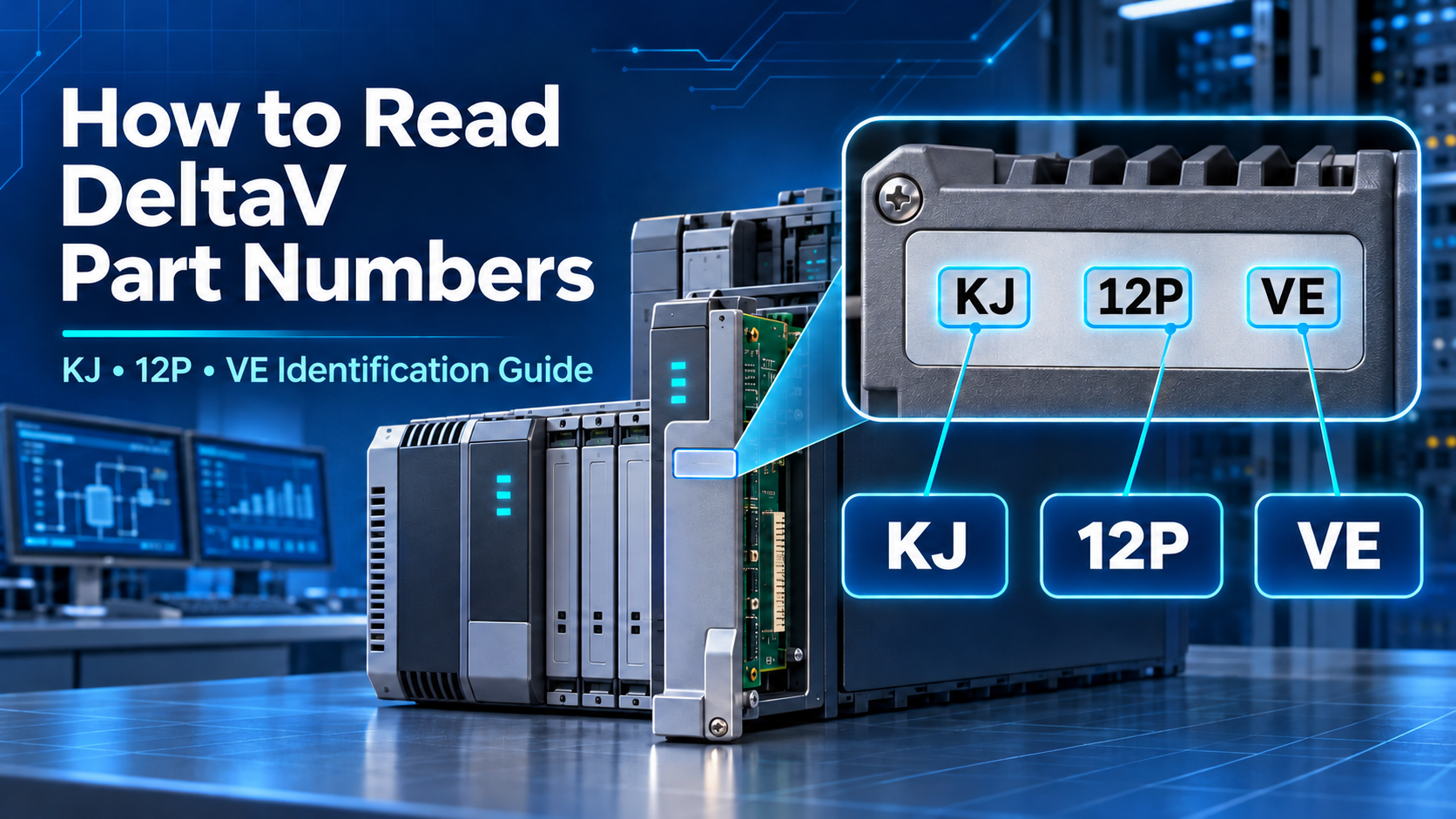
A DeltaV module may show a KJ hardware identifier, one or more 12P references and a VE model number in product documents or quotations. These numbers are related, but they are not interchangeable. Recording every identifier exactly is the safest way to confirm the hardware, termination option, revision and orderable assembly before buying a replacement.
Why All Three Identifiers Matter
DeltaV hardware is modular. A complete installation can include a controller or I/O card, a carrier, a terminal block, field-power components and redundancy hardware. Two items can have the same general function and nearly identical front panels while differing in series, termination, channel count, redundancy, coating or supported DeltaV release.
For that reason, do not send only “DeltaV analog input card” or only the first part of a number. Photograph the complete nameplate and record the KJ, 12P and VE references whenever they are available. Also record the hardware revision, serial number, installed DeltaV version and the model of the mating carrier or terminal block.
KJ, 12P and VE at a Glance
| Identifier | What It Commonly Identifies | How to Use It |
|---|---|---|
| KJ | A specific physical hardware item such as an I/O card, controller component, terminal block or spare part | Copy the complete prefix, body and suffix exactly from the label |
| 12P | An Emerson/Fisher-Rosemount part, assembly, drawing or document reference, depending on where it appears | Read the field label around it; never assume every 12P number has the same role |
| VE | An orderable model or configured assembly listed in DeltaV ordering information | Use it to confirm what the ordered package includes, such as the card and termination option |
How to Read a KJ Hardware Number
A KJ identifier normally points to the physical hardware in front of you. Examples include KJ3222X1-BA1 for an eight-channel 4–20 mA HART analog input card and KJ3242X1-BA1 for an earlier M-Series FOUNDATION Fieldbus H1 interface card. The complete suffix is important: changing BA1 to BA2, BA3 or BK1 can indicate a different generation, series, platform or hardware variant.
Do not remove spaces, punctuation or suffix characters when you first record the number. You may normalize spacing later for a database search, but the source record should preserve the label exactly. If the last character is damaged, photograph the front, side and rear labels as well as the carrier position.
Important: the letters and numbers inside a KJ code are not a universal public decoding formula. Verify the complete identifier in the applicable Emerson product data sheet, certificate or hardware manual.
How to Read a 12P Reference
A number beginning with 12P must be interpreted in context. On a module label it can be an associated part or assembly number. In an Emerson data sheet it can also identify an installation drawing or technical document. For example, official DeltaV documents reference 12P1293 for M-Series Class 1 Division 2 installation instructions and 12P2046 for Zone 2 installation instructions.
Look at the words immediately beside the number: Part No., P/N, Assembly, Drawing, Installation Instructions or another label. When requesting a spare, send the 12P number together with the KJ number rather than replacing one with the other. The additional identifier can help distinguish production revisions or confirm exactly which labeled assembly is installed.
If the 12P marking on an old module differs from an online listing, do not assume the listing is wrong or that the items are interchangeable. Ask for label photos and compare the complete hardware revision, channel type, terminal block, carrier and system version.
How to Read a VE Model Number
VE numbers appear in Emerson ordering information and usually describe an orderable product or configured hardware package. A short VE number can identify a controller, such as VE3008 for the MQ Controller or VE3007 for the MX Controller. Longer VE model numbers can distinguish an I/O card package by channel type, termination block, mass termination or redundancy arrangement.
For example, Emerson lists VE4003S2B1 as an eight-channel 4–20 mA HART analog input package with a standard I/O termination block. Related VE4003 combinations use different fused, four-wire or mass-termination options, while VE4033 variants can identify redundant arrangements. The physical card inside the package can still carry its own KJ and 12P markings.
This is why a VE model from a quotation and a KJ number from the module label can both be correct. One identifies the orderable configuration; the other identifies a particular hardware item within that configuration.
A Reliable Identification Workflow
- Photograph the complete module. Take one front image, one close-up of every label and one image showing the installed carrier and terminal block.
- Copy every identifier. Record KJ, 12P, VE, serial number, hardware revision, date code and certification markings exactly as printed.
- Identify the hardware function. Confirm controller, analog input, discrete output, Fieldbus interface, power supply, carrier or terminal block.
- Check the signal and channel details. Record voltage, current range, HART support, channel count, isolation and field-power requirements.
- Confirm the installed DeltaV release. Some cards and controllers require minimum software versions or specific carrier families.
- Verify what is included. A VE package may include a card and terminal block, while a spare listing may include only the card.
Common Identification Mistakes
- Searching only the first part of a KJ number and ignoring the final suffix.
- Treating every 12P number as a module model even when it identifies a drawing or installation document.
- Assuming a VE package contains the same terminal block or redundancy hardware as the installed assembly.
- Ordering from a front-panel photo without checking the side label, carrier and termination hardware.
- Assuming a newer revision is automatically compatible with an older DeltaV software release.
- Using a similar-looking M-Series or S-Series card without checking the platform, carrier and terminal-block keying.
Recommended DeltaV Models to Review
These examples show how KJ, 12P and VE identifiers appear across controllers, I/O and supporting hardware. They are not automatic replacements for one another.
| Identifier | Product / Function | Key Check |
|---|---|---|
| VE3008 | DeltaV MQ Controller | DeltaV release, carrier, power supply and redundancy |
| VE3007 | DeltaV MX Controller | System capacity, release and redundant partner |
| KJ2003X1-BA2 / 12P2093X112 | MD Plus controller family | Full suffix, revision and installed software |
| KJ3222X1-BA1 | 8-channel 4–20 mA HART analog input card | 12P label, terminal block and redundancy |
| KJ3202X1-BA1 / 12P2536X042 | 8-channel 24 VDC high-side discrete output | Load, field power and terminal block |
| KJ3203X1-BA1 / 12P3270X022 | 32-channel 24 VDC dry-contact input | Channel wiring, carrier and hardware revision |
| KJ3242X1-BA1 / 12P2471X042 | M-Series FOUNDATION Fieldbus H1 interface | DeltaV version, segment power and termination |
| VE4003S2B1 | 8-channel AI HART with standard termination block | Package contents and exact card label |
| VE4005S2B1 | 8-channel AO HART with standard termination block | Output type, terminal block and redundancy |
| VE4206P2 | M-Series two-port serial interface package | Driver, protocol and supported DeltaV release |
| VE5123 | 100–240 VAC to 24 VDC, 10 A bulk power supply | Input voltage, output capacity and coating option |
Official Verification Resources
Before ordering or approving a replacement, compare the complete identifiers with the documentation for the exact hardware generation:
Request a DeltaV Quote
Send clear photos of every label, the complete KJ, 12P and VE identifiers, required quantity, preferred condition and destination country. If the module is installed, include the DeltaV version, carrier, terminal block and redundancy configuration.
Email: [email protected]
WhatsApp: +86 18159889985
DeltaV and related product names are trademarks of their respective owners and are used for identification and informational purposes only. Compatibility and installation decisions should be reviewed by qualified personnel using the current manufacturer documentation and the site’s approved procedures.
Table of Contents
- Why All Three Identifiers Matter
- KJ, 12P and VE at a Glance
- How to Read a KJ Hardware Number
- How to Read a 12P Reference
- How to Read a VE Model Number
- A Reliable Identification Workflow
- Common Identification Mistakes
- Recommended DeltaV Models to Review
- Official Verification Resources
- Request a DeltaV Quote