Against the backdrop of the global manufacturing industry’s accelerating shift toward digitalization and intelligence, industrial automation systems are undergoing a profound transformation from “centralized control” to “distributed collaborative control.” As one of the key foundational devices in this transformation process, the FC-RUSIO-3224 remote safety I/O module is increasingly being deployed in core control architectures across various industries, gradually evolving from a traditional “field data acquisition unit” into a “key control node.”
Industry experts generally believe that this shift not only reflects the technological upgrade path of industrial control systems but also highlights the growing demands of modern industrial environments for real-time performance, system security, and scalability.
Traditional industrial automation systems typically rely on centralized control rooms for unified management, with field devices connected to controllers via long-distance cabling. While this architecture remains stable in small- to medium-scale systems, large-scale industrial environments increasingly expose several limitations, including:
With the continued advancement of Industry 4.0 and smart manufacturing, enterprises are steadily transitioning toward a “distributed control + edge processing” architecture, shifting part of control logic and data processing closer to the field layer.
Under this trend, the importance of remote I/O modules has significantly increased. The FC-RUSIO-3224 has emerged as one of the key devices widely recognized in this architectural transformation.
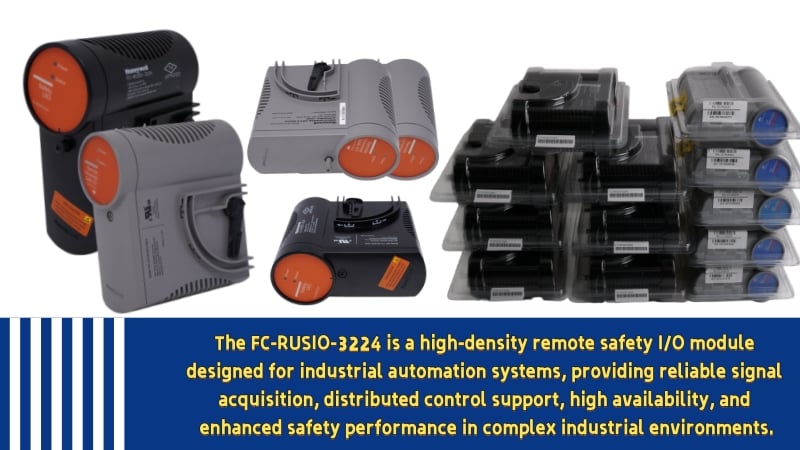
The FC-RUSIO-3224 is a high-density remote safety I/O module typically used for field signal acquisition and control execution in industrial automation systems. Its design emphasizes high reliability, high density, and high safety.
The FC-RUSIO-3224 supports up to 32 configurable I/O channels, capable of simultaneously processing both digital and analog signals. This high-density design significantly reduces hardware footprint, making it suitable for space-constrained but signal-intensive industrial environments.
In industries such as petrochemicals, power generation, and metallurgy, field environments are often characterized by complex signal types and strong electromagnetic interference. The module demonstrates strong signal adaptability, ensuring stable data acquisition performance even under high-noise conditions.
The FC-RUSIO-3224 is commonly deployed in Safety Instrumented Systems (SIS) or high-integrity control architectures, featuring a fail-safe design philosophy. In abnormal conditions, it automatically transitions into a safe state, thereby reducing the risk of industrial incidents.
Through redundant communication mechanisms and modular design, the device maintains essential system functionality even in the event of partial component failure, significantly improving overall system availability and operational stability.
Traditionally, I/O modules primarily perform signal conversion and transmission functions. However, as industrial systems become increasingly complex, this role is undergoing a fundamental transformation.
The FC-RUSIO-3224 is now regarded as a “critical control node” for three main reasons:
Modern industrial systems are increasingly pushing control logic closer to field devices, enabling I/O modules to handle not only data transmission but also real-time control and logical decision-making.
In smart factory architectures, the real-time accuracy and reliability of field data directly influence higher-level control strategies. As a data entry node, the FC-RUSIO-3224 plays a critical role in determining overall system decision quality.
Industrial control systems are gradually moving away from centralized architectures toward multi-node collaborative frameworks. In such systems, each remote I/O module becomes a vital component of the overall network.
Within smart manufacturing systems, the FC-RUSIO-3224 is not merely a hardware device but a critical bridge connecting the field device layer and the control system layer.
Its core value is reflected in:
As the value of industrial data continues to rise, remote I/O devices like the FC-RUSIO-3224 are increasingly becoming essential components of the “nerve endings” of smart factories.
Industry experts point out that the future development of remote I/O modules will follow three major trends:
Meeting increasingly strict functional safety requirements and adapting to critical infrastructure and high-risk industrial scenarios.
Evolving from simple data acquisition devices into platforms capable of edge computing and local decision-making.
Achieving tighter integration with DCS, PLC, and SIS systems, becoming an integral part of unified industrial control architectures.
The FC-RUSIO-3224 represents a typical example of this technological evolution path.
As industrial automation systems continue to evolve toward distributed, intelligent, and high-security architectures, the role of remote I/O modules is being fundamentally redefined. With its high-density design, system compatibility, and safety-oriented features, the FC-RUSIO-3224 is steadily becoming a critical foundational node in modern industrial control systems.
In future industrial network architectures, the importance of such devices will not diminish; instead, it will continue to grow as system complexity increases, serving as a vital enabling force for intelligent manufacturing and industrial digital transformation.
 EN
EN