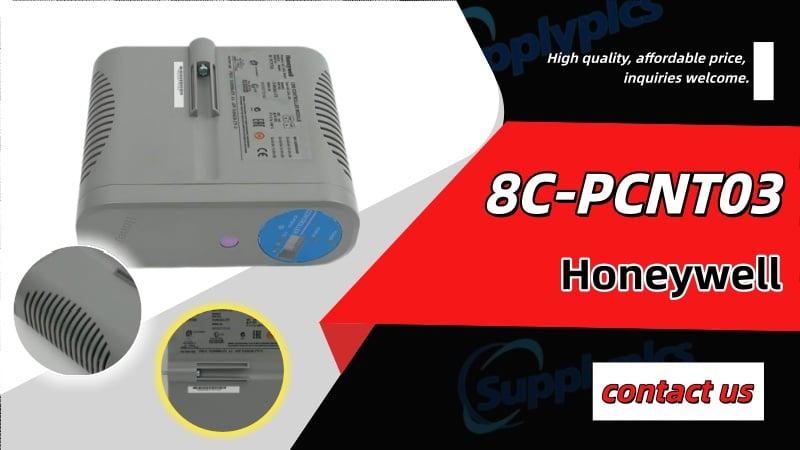
The model numbers 8C-PCNT01, 8C-PCNT02, and 8C-PCNT03 are similar enough to cause confusion. All three are commonly listed as Honeywell C300 controllers and may even appear together on the same industrial spare-parts sheet. However, this does not mean that a technician can remove one controller and install another without first checking compatibility.
These models belong to the Honeywell Series 8 C300 controller family and are used in Experion systems. The final two digits may identify a hardware revision, firmware requirement, supported Experion release, or product lifecycle stage. Although the 8C-PCNT03 may appear to be newer than the unit already installed, “newer” does not necessarily mean “compatible.”
The reason is straightforward. A C300 controller is part of a larger Honeywell Experion PKS distributed control system. It executes the plant’s control logic, communicates with Series 8 I/O, and works with other system hardware and software. If one element of that environment is incompatible, replacing the controller may be more complicated than expected.
The following table provides a practical comparison without suggesting that the three modules are freely interchangeable.
| Model on the label | Where it may be encountered | What to verify first |
|---|---|---|
| 8C-PCNT01 | Earlier Experion PKS equipment records and spare-parts lists | Complete part number and installed firmware |
| 8C-PCNT02 | Existing Honeywell Series 8 C300 installations | Experion release and controller IOTA |
| 8C-PCNT03 | Later replacement projects and purchasing inquiries | Approved replacement path and redundancy requirements |
All three models perform the general role of a C300 process controller. The important question is whether the proposed replacement is suitable for the system already operating at the plant. The following six sections cover the main points that should be checked.
The first difference concerns the hardware generation or product revision represented by each model number. The progression from 8C-PCNT01 to 8C-PCNT02 and 8C-PCNT03 should not be interpreted as a simple basic-to-premium performance scale.
Honeywell may introduce a new controller revision because of component updates, manufacturing changes, firmware development, certification requirements, product qualification, or lifecycle planning. Some of these changes may have little effect on routine control functions, but they can still influence installation and replacement compatibility.
The abbreviated 8C-PCNT model number may also be accompanied by a longer Honeywell material or assembly number. Buyers should record every number shown on the controller label, as the extended part number may identify a specific hardware variant.
Technical information published by online suppliers is not always consistent. Processor, memory, temperature, and capacity figures may vary from one listing to another. The installed nameplate, official Honeywell documentation, and approved plant records should therefore take priority over unverified marketplace specifications.
The second difference involves Honeywell C300 controller compatibility with the installed Experion environment. A C300 is not a standalone PLC module that can be selected only by checking its dimensions, connectors, and power requirements. It operates within an integrated Honeywell Experion PKS architecture.
An Experion installation includes C300 firmware, engineering software, control databases, network infrastructure, Series 8 I/O definitions, servers, and operator stations. A controller supported by one Experion release may require additional verification, a software upgrade, or different supporting hardware when used with another release.
Before purchasing an 8C-PCNT01, 8C-PCNT02, or 8C-PCNT03, the plant should identify the exact Experion PKS version currently installed. The engineering team should then confirm that the proposed C300 controller revision is supported by that system environment.
This verification is particularly important for legacy Honeywell DCS installations. A later controller may be an approved replacement for an earlier model, but a system software or firmware update may still be necessary. Conversely, an older controller held in spare inventory may not be compatible with a newer Experion PKS release.
The third difference is the relationship between the C300 hardware revision and controller firmware. Even when two controllers look physically identical, they may contain different firmware versions or require different preparation before commissioning.
The firmware must be compatible with the installed Experion release and the plant’s approved control-system configuration. A replacement C300 controller may require firmware loading before it can communicate correctly, accept the control application, or operate as part of a redundant controller pair.
Moving from an 8C-PCNT01 to an 8C-PCNT02 or 8C-PCNT03 does not necessarily require the entire control strategy to be rebuilt. Nevertheless, the Experion application, controller database, firmware, and supporting software must be reviewed together.
After installation, commissioning should verify network communication, control execution, alarms, events, controller loading, restart behavior, and the operation of affected process loops. Any firmware update or hardware change should follow the plant’s configuration-backup, testing, management-of-change, and approval procedures.
The fourth difference concerns the controller IOTA and physical installation. Honeywell Series 8 hardware uses an Input/Output Termination Assembly, commonly called an IOTA, to provide mounting and electrical connections for the C300 controller.
When comparing 8C-PCNT01 vs. 8C-PCNT02 vs. 8C-PCNT03, maintenance personnel should check the installed IOTA model, controller position, cabinet layout, power distribution, connectors, and related hardware. A C300 processor should not be purchased based only on a photograph of its front label.
A proposed controller may appear physically suitable while still requiring a different IOTA revision or another approved installation change. Engineers should confirm that the existing IOTA supports the intended replacement before placing an order.
Connector damage, cabinet contamination, unstable power, poor grounding, or IOTA deterioration can also produce symptoms that resemble a controller failure. Inspecting the complete assembly reduces the risk of installing another controller without correcting the underlying problem.
The fifth difference concerns C300 redundancy and replacement compatibility. In a redundant Honeywell C300 configuration, two controllers operate together to improve system availability. Their hardware revisions, firmware levels, configurations, and synchronization requirements must be compatible.
A plant should not assume that an 8C-PCNT03 can operate directly with an installed 8C-PCNT01 simply because both belong to the Series 8 C300 family. Mixed-revision operation should be confirmed using the Honeywell documentation applicable to the specific Experion release.
Before replacing a controller, technicians should identify the active and secondary units, confirm their synchronization status, and review the approved switchover procedure. Following installation, commissioning should test controller synchronization, network communication, alarms, redundancy status, and switchover performance.
Supplier descriptions such as “same series” or “newer version” do not provide sufficient evidence of compatibility. A proposed C300 controller replacement should be supported by an approved and traceable technical cross-reference.
The sixth difference involves product availability and lifecycle status. Honeywell 8C-PCNT01, 8C-PCNT02, and 8C-PCNT03 controllers may be offered as factory-new, unused surplus, repaired, refurbished, or used equipment. Availability in the market does not automatically make a particular model suitable for the installed system.
An accurate request for quotation should include the short model number, extended assembly number, hardware revision, firmware level, Experion release, IOTA number, required quantity, and preferred condition. It should also state whether the controller is intended for a simplex system, redundant pair, immediate replacement, or spare-parts inventory.
Buyers should request clear serial-number photographs, test documentation, storage information, repair history, warranty terms, and return conditions. The higher suffix alone is not a sufficient reason to select the 8C-PCNT03 instead of an 8C-PCNT01 or 8C-PCNT02.
The correct choice is usually the exact controller approved for the installed system or a formally documented successor. Long-term spare-parts planning should also cover compatible IOTA hardware, validated configuration backups, supported firmware, and qualified commissioning personnel.
The principal difference between Honeywell 8C-PCNT01, 8C-PCNT02, and 8C-PCNT03 lies in their individual product and revision identities within the Series 8 C300 family. Although they perform the same general role in Experion-based process control, their similar model numbers do not guarantee direct interchangeability.
A reliable comparison should cover six areas: hardware revision, Experion PKS compatibility, firmware, IOTA, redundancy, and lifecycle status. Verifying these details before ordering can help plants avoid unsuitable spare parts, maintenance delays, and unexpected commissioning problems.
We offer high-quality industrial automation products and professional technical support. Please contact us for more information.
Sales manager:Jim Pei
Wechat: ZXH18020776782
 EN
EN