Most plants do not replace a working control system simply because newer hardware is available. The shutdown, engineering work, and recommissioning can make a full upgrade difficult to justify. If a plant is already running SIMATIC PCS 7, the first choice is often to keep the existing system working with compatible hardware.
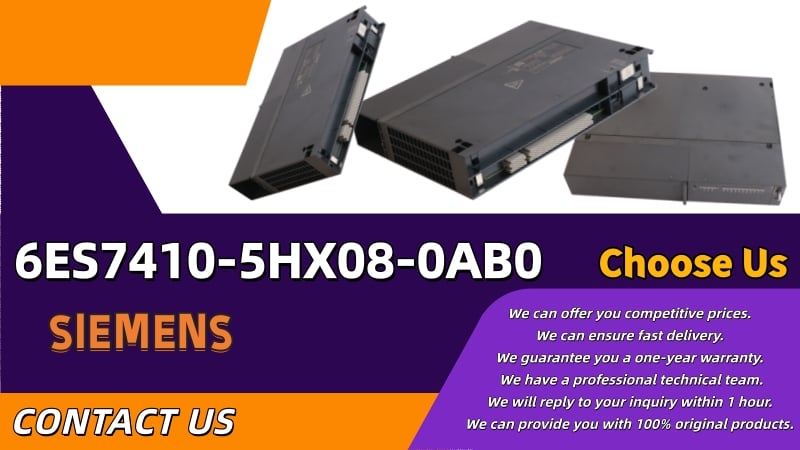
One component used in these systems is the Siemens CPU 410-5H, order number 6ES7410-5HX08-0AB0. It is a process automation CPU for S7-400 and S7-400H/F/FH configurations. At the time of writing, Siemens still lists this model as an active product.
If you are looking for a replacement CPU, the order number is only the first thing to check. The PCS 7 version, firmware, System Expansion Card, licenses, network setup, and redundancy configuration also need to match. The six points below cover the main details to review before buying a 6ES7410-5HX08-0AB0 Siemens PLC CPU module.
Ask an engineer responsible for a process plant what matters most in a controller, and raw processing speed probably will not be the first answer. The controller has to run reliably day after day, pass data between different parts of the plant, and provide useful diagnostic information when something goes wrong.
That is the kind of work the Siemens CPU 410-5H is designed to handle. In a SIMATIC PCS 7 process automation system, it runs the control program and communicates with distributed I/O, operator stations, engineering stations, and other connected equipment.
The order number 6ES7410-5HX08-0AB0 is compatible with S7-400 systems and can also be used in fault-tolerant or fail-safe S7-400H/F/FH configurations. This is particularly useful in plants where a controller failure could interrupt production or create a difficult restart.
For an existing PCS 7 installation, staying with the CPU 410-5H may also reduce the amount of re-engineering required. Maintenance teams can continue working with a familiar Siemens PLC platform, while companies may be able to reuse compatible hardware, project knowledge, and spare-parts procedures.
Of course, ordering the same part number does not automatically guarantee a straightforward replacement. Before purchasing a Siemens 6ES7410-5HX08-0AB0 PLC CPU module, it is worth checking the installed PCS 7 version, firmware, licenses, hardware revision, System Expansion Card, and redundancy setup. These details are easy to overlook, but they often determine whether the replacement can be commissioned without unexpected delays.
Process automation performance involves cyclic control, communications, diagnostics, alarms, and data exchange. Siemens documentation for the CPU 410-5H lists 48 MB of integrated load memory and 16 MB of RAM each for program and data, providing capacity for substantial process-control applications.
An important feature of the CPU 410 platform is its use of a System Expansion Card, commonly abbreviated as SEC. The card specifies licensed process-object capacity and enables the CPU to be scaled for the needs of a particular PCS 7 project. This can give plant owners a more flexible path when an automation system grows, because capacity planning can be aligned with the number of process objects rather than treated as a simple one-size-fits-all decision.
Buyers should note a crucial detail in the official product description: 6ES7410-5HX08-0AB0 is supplied without a System Expansion Card and is identified for spare-part use. The CPU and SEC should therefore not be treated as interchangeable ordering items. Before purchasing, an engineer should confirm the required process-object license, existing SEC, firmware level, and target system configuration. This verification prevents a seemingly correct Siemens PLC spare part from arriving without an essential element needed for commissioning.
Unplanned downtime can result in lost production, off-spec material, additional energy consumption, and difficult restart procedures. For critical processes, a redundant PLC architecture can reduce dependence on a single controller. The “H” in CPU 410-5H reflects its role in high-availability configurations, while Siemens also identifies the controller as having fault-tolerant and fail-safe capability when it is engineered with the appropriate system components and software.
In an S7-400H redundant automation system, two CPU 410-5H units can be synchronized so that the control function is not concentrated in one processor. The cataloged CPU provides two interfaces for synchronization modules. Siemens documentation states that synchronization modules are connected in pairs using fiber-optic links, creating the communication path between the redundant CPUs. This architecture helps a correctly designed system maintain process control through specified component faults or maintenance events.
Redundancy is not a guarantee of zero downtime. Availability depends on the complete design, including racks, power supplies, networks, distributed I/O, synchronization links, software, diagnostics, maintenance, and testing. Safety-related operation also requires approved fail-safe engineering and an appropriate plant risk assessment.
For operators in high-consequence industries, the practical benefit is resilience. A properly engineered SIMATIC PCS 7 and S7-400H system can provide more options for responding to faults while reducing dependence on one component. This makes the CPU 410-5H relevant to searches for a fault-tolerant PLC, redundant Siemens controller, and high-availability process automation solution.
Modernization projects rarely start with a blank plant. Facilities often combine Ethernet-based automation, fieldbus installations, packaged equipment, and remote I/O from different project phases. A process automation CPU must connect these layers without forcing an unnecessary rip-and-replace project.
The Siemens 6ES7410-5HX08-0AB0 product description lists five interfaces: two PN interfaces, one DP interface, and two interfaces for synchronization modules. In practical terms, PROFINET supports Ethernet-based industrial communication and distributed I/O, while PROFIBUS DP remains important in many installed process plants. Siemens technical information also lists support for as many as 96 DP slaves on the integrated PROFIBUS DP master interface, subject to the engineered system limits and configuration.
This combination helps the CPU 410-5H bridge legacy and modern automation requirements. Plants may retain qualified PROFIBUS assets where replacement offers little operational benefit while using PROFINET for new distributed I/O or network segments. The synchronization connections support redundant controller operation rather than ordinary plant-network traffic.
Successful integration still requires network engineering. Device limits, update times, topology, redundancy, time synchronization, cybersecurity, and supported versions should be reviewed. Engineers should use Siemens manuals and compatibility lists rather than assuming every PROFINET or PROFIBUS device is qualified.
The strongest case for process automation is the operational outcome. A CPU 410-5H-based PCS 7 system can support stable control, centralized diagnostics, standardized engineering, and high-availability architectures wherever interruptions are expensive or unsafe.
In oil and gas facilities, redundant process control can support continuous handling, compression, separation, and utility systems. Chemical plants depend on repeatable control, interlocks, and coordinated sequences. Power and water operators value clear diagnostics and reliable communication with distributed assets. Pharmaceutical and food producers may prioritize traceable operations, consistent batches, and carefully managed changes. The exact architecture differs by industry, but the shared objective is dependable industrial automation over a long operating life.
Standardizing on a known Siemens PLC platform may also simplify training, engineering libraries, troubleshooting, and spare-parts management across multiple sites. However, organizations should balance continuity with lifecycle planning. At the time of publication, Siemens SiePortal lists 6ES7410-5HX08-0AB0 as an active product, but buyers should always verify the current regional lifecycle status, delivery information, software release, and approved hardware before placing an order.
For procurement teams, this makes total cost of ownership more useful than unit price alone. Engineering hours, planned shutdown time, license requirements, compatibility, warranty, logistics, and supplier traceability can outweigh a small difference in the quoted CPU 410-5H price.
The exact Siemens article number is the starting point, not the entire specification. Before requesting a quotation, buyers should document the installed CPU order number, hardware revision, firmware, PCS 7 or STEP 7 environment, redundancy arrangement, System Expansion Card, synchronization modules, and required process-object capacity. Photographs of the existing nameplate and rack can help a qualified engineer or supplier identify configuration differences.
Compatibility should be verified against current Siemens documentation. A replacement project must consider whether the module will operate with the existing software, communication processors, I/O stations, fail-safe program, and partner CPU in a redundant pair. Siemens documentation notes that redundant CPU 410 units cannot be operated with two different SECs, which makes matched configuration particularly important.
Commercial checks are equally important when sourcing industrial automation parts internationally. Ask whether the Siemens 6ES7410-5HX08-0AB0 is factory-new, surplus-new, used, or refurbished; request traceable photos and serial information; confirm the warranty terms in writing; and clarify whether the quotation includes the SEC or any accessories. The official part number is described without the System Expansion Card, so a low price may represent a CPU-only offer rather than a commissioning-ready package.
Global customers should confirm lead time, destination, shipping, packaging, returns, and technical support. For an emergency PLC spare part, define storage and periodic testing. For immediate installation, back up firmware and configuration before shutdown. A strong Siemens PLC supplier should accurately describe condition, scope, compatibility, documentation, and after-sales responsibility—not merely display “in stock.”
We offer quality industrial automation products and professional support. Contact us for the 6ES7410-5HX08-0AB0 or other spare parts.
Sales manager:Jim Pei
Wechat: ZXH18020776782
 EN
EN