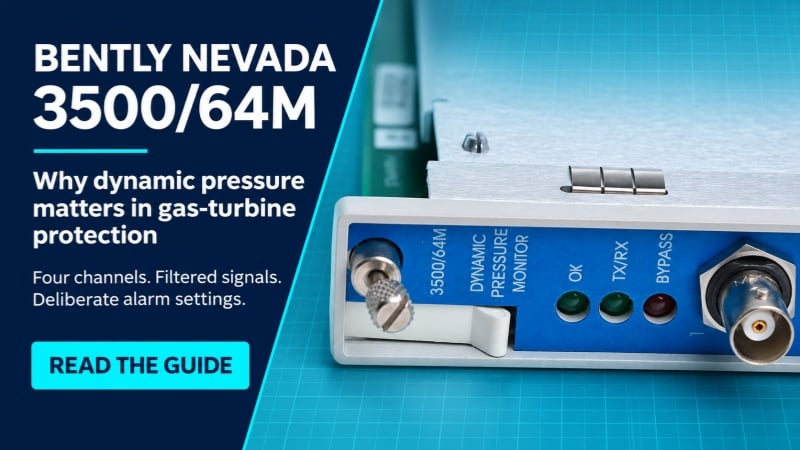
A practical look at four-channel processing, band-pass filtering, alarm timing and replacement checks for teams responsible for turbine availability.
In gas-turbine maintenance, dynamic pressure is an operational signal that cannot be overlooked. Pressure fluctuations can appear before a clear equipment problem, so stable acquisition and analysis help teams assess operating status, establish protection thresholds and schedule maintenance with better evidence.
The Bently Nevada 3500/64M Dynamic Pressure Monitor is a single-slot, four-channel module for receiving signals from high-temperature pressure sensors and supplying protection data to the 3500 system through configured alarm setpoints.
Its primary measurement variable is band-pass dynamic pressure. Instead of presenting only a static pressure value, it processes pressure within a defined frequency range so engineers can see meaningful fluctuations during the combustion process.
The 3500/64 series is intended for dynamic-pressure and combustion-pressure sensor signals in gas turbines. The monitor converts sensor signals into channel variables and evaluates them against user-defined Alert and Danger levels.
Trend information gives operators a chance to investigate combustion behaviour before a visible performance decline becomes a protection event.
The 3500/64M accepts between one and four pressure-sensor signals. Multiple measurement points can be used to observe different combustion zones or compare pressure behaviour under different operating conditions.
Each active channel can produce its own measurement variables and use independent alarm setpoints. That arrangement keeps several pressure signals inside one 3500 rack while helping maintenance personnel trace an alarm back to the relevant sensor location.
A single sensor input can be routed to four channels. Each channel can use its own band-pass filter range and full-scale range for multi-band analysis.
Before changing a card, record how many sensors are in service, where they terminate and whether the installation uses independent channels or a cascaded signal.
Dynamic pressure signals can contain several frequency components. Mechanical noise, electrical interference and unrelated process activity can distort the information used for an alarm decision if they are not conditioned correctly.
The 3500 Rack Configuration Software allows band-pass corner frequencies and additional notch filters to be configured. Channels 1 and 2 form one filter group, while channels 3 and 4 form another; channels inside a group share the filtering mode, but the two groups can use different band-pass settings.
Filter values should be chosen around the pressure sensor, combustor design, operating-speed range and historical trends. A range that is too narrow can hide useful behaviour; a range that is too broad can increase nuisance alarms.
The monitor compares measured values with configured thresholds and triggers system alarms when the defined criteria are met. Alert and Danger levels can be configured through the 3500 Rack Configuration Software.
The 3500/64M provides an independent Recorder Output for each channel. Its value is scaled against the monitor full-scale range and can be connected to a control system or external recording equipment.
That output can preserve pressure trends, support operational analysis and help correlate dynamic-pressure behaviour with load, temperature and rotational speed. A short at the output does not interrupt the monitor’s own operation.
Procurement should be based on the complete installed configuration rather than only the “3500/64M” characters on a request. Confirm the module label, spare-part number, I/O arrangement and current system documentation before committing to a replacement.
176449-05 is used as a spare-part reference for the 3500/64M Dynamic Pressure Monitor. The installed nameplate and I/O configuration should still govern the final procurement decision.
A reliable replacement review pairs the product label with the system context.
Additional model references supplied for cross-checking, maintenance planning and hard-to-find component enquiries.
| OKP0N34 | D4-L MF6FTJ0026 | ABB PM861AK01 3BSE018157R1 |
| 4210 | 00322513-02 | ADV159-P00 |
| WDC20TH 5J.JKJ28.E30 | AAM11-S2 | 03144-1033-3103 |
| J120-190 | 51202329-402 | MS4609F1210 |
| NET-C3 IDA8 | RCP-64PB-OLED | TSXRAM25616 |
| SM87PBLAUL3BOYGHRZ | 63450-1.0-230 | MH192 |
| QSGR-3P | SL2500 | 3349RBYN00022AAA-AR1 |
| PAIH03 | LN15SE2-1243 | TM-107 TTM-107-0-RN |
| CXD4.2 | MA-63 3063-4013 | XLS3000-CPUD |
| RED1200 6EP4348-7RB00-0AX0 | iv-6A | X13760335-01 TD7 |
| QL-NE100 | VEP1485 | 1026112-40 |
| 554.0452 | PSA1400/24S1-ROAC 96-019-000-01 | NW-BM85C002 |
Share the module label, rack position, sensor details and current I/O information for a focused sourcing discussion.
 EN