Process Automation System Guide
SIMATIC PCS 7 is more than a controller platform. It is a distributed control system that brings automation systems, engineering and operator stations, industrial networks, and process I/O into one coordinated architecture. Understanding how these layers work together is essential when planning an expansion, selecting spare parts, or maintaining an installed plant.
Siemens SIMATIC PCS 7 is a distributed control system designed for continuous and batch-oriented process industries. Typical applications include chemical production, oil and gas, power generation, water treatment, pharmaceuticals, food processing, metals, cement, and other plants where long operating cycles, clear diagnostics, and controlled system changes are important.
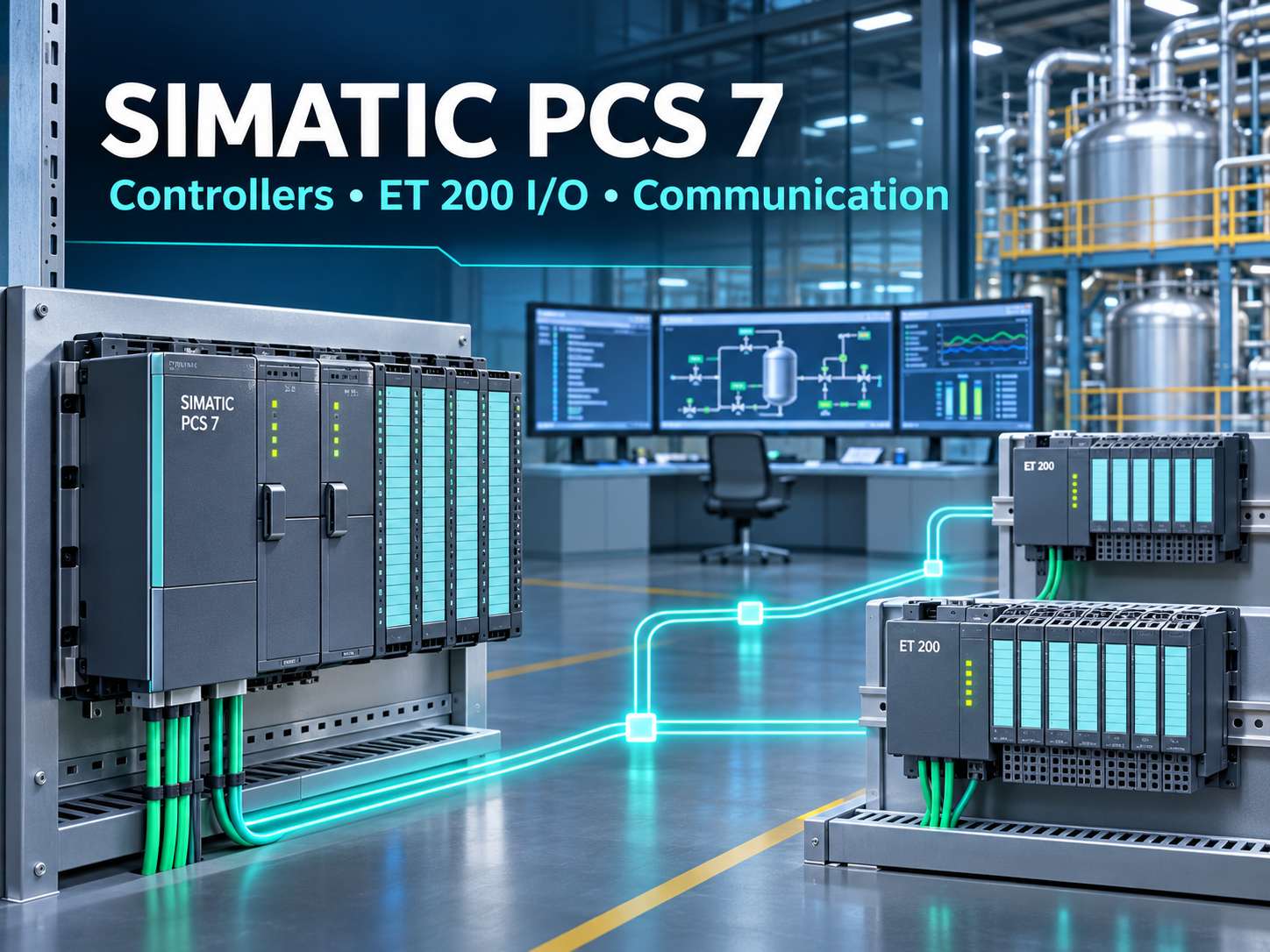
A PCS 7 installation normally combines an Engineering System, one or more Automation Systems, Operator System servers and clients, industrial communication networks, and distributed I/O. The exact configuration can range from a compact single-station project to a redundant multi-server plant. Because the system is engineered as an integrated whole, a spare module should never be selected only by appearance or product family. The PCS 7 version, released hardware list, firmware, process-object licensing, redundancy concept, communication interface, and field wiring must all be reviewed.
The Automation System, usually abbreviated as AS, executes control logic, reads process signals, writes outputs, manages diagnostics, and exchanges data with operator and engineering stations. In current PCS 7 architectures, AS 410 systems based on the CPU 410 family are central options for new process-control projects. Siemens documentation identifies the CPU 410-5H Process Automation and CPU 410E Process Automation as scalable controller choices, with options for standard, high-availability, and safety-related applications depending on the configured system.
The CPU 410-5H is used where a high-performance, scalable automation system is required. It can be configured as a single controller or as a redundant pair. CPU 410E provides a related platform for smaller process-object ranges while retaining the PCS 7 engineering approach. Existing plants may also contain earlier AS 41x systems. These legacy controllers remain important for maintenance, but their suitability, lifecycle position, and upgrade path must be checked against the exact PCS 7 release.
Before replacing a controller, record the full order number, hardware revision, firmware, System Expansion Card or process-object capacity, rack and power-supply arrangement, synchronization modules, communication processors, redundancy configuration, and the PCS 7 engineering version. A verified project backup and an approved shutdown and restoration procedure are essential.
Distributed I/O brings process signals closer to sensors and actuators, reduces long field-cable runs, and makes plant sections easier to organize. SIMATIC ET 200 families provide interface modules, digital and analog I/O, HART-capable modules, fail-safe options, and components for different cabinet and environmental requirements.
ET 200SP HA is a major process-I/O platform for modern PCS 7 architectures. It supports PROFINET IO communication, compact channel density, flexible expansion, and high-availability configurations. Depending on the design, redundant network paths and redundant controllers can be used to maintain communication after a cable, interface, or controller failure. ET 200M remains common in established PCS 7 plants and is still relevant when identifying installed spares or planning a staged migration.
When ordering an I/O spare, confirm more than the signal type. Check the interface module, base or terminal unit, channel count, voltage or current range, isolation, HART support, hazardous-area requirements, fail-safe approval, firmware, front connector, and the system release in which the module is approved. A mechanically similar I/O module can have a different electrical function or diagnostic behavior.
PCS 7 separates communication according to system function. The terminal bus connects operator clients, operator servers, engineering stations, and management components. The plant bus connects automation systems with operator servers and engineering resources. At controller and field level, PROFINET IO and PROFIBUS DP may connect distributed I/O, drives, motor-management systems, field devices, and network links.
Modern AS 410 controllers include PROFINET interfaces that can connect remote I/O such as ET 200SP HA. Existing systems may also use communication processors, PROFIBUS interfaces, Industrial Ethernet components, fiber links, and redundancy mechanisms. Protocol names alone do not prove compatibility: the configured topology, device role, firmware, address plan, transmission medium, redundancy method, and released module list must be compared.
Before replacing a communication component, preserve IP addresses, PROFIBUS addresses, device names, switch and ring settings, network diagrams, and screenshots of the original configuration. Also inspect connectors, fiber modules, termination, shielding, grounding, and power. Many apparent controller or I/O failures are ultimately caused by network configuration or physical-layer faults.
The following components are useful reference points when reviewing a PCS 7 project. They are not automatic replacements. Confirm the complete order number, hardware version, firmware, PCS 7 release, licensing, redundancy, and installed accessories before ordering.
| Model / Family | Category | Typical Reason to Review | Confirm Before Ordering |
|---|---|---|---|
|
CPU 410-5H 6ES7410-5HX08-0AB0 |
PCS 7 controller | Scalable standard, redundant, or safety-related AS 410 projects | Firmware, process objects, redundancy, PCS 7 release |
|
CPU 410E 6ES7410-5HM08-0AB0 |
PCS 7 controller | Smaller AS 410 process-object ranges | License capacity, firmware, rack and project release |
| ET 200SP HA | Distributed process I/O | Modern PROFINET-based process I/O and high availability | Interface module, terminal blocks, signal modules, redundancy |
| ET 200M / IM 153-2 | Installed distributed I/O | Legacy PCS 7 spare identification or staged migration | Exact IM revision, bus protocol, module approval and lifecycle |
| CP 443-1 | Industrial Ethernet communication | Existing S7-400 / PCS 7 network configurations | Full suffix, firmware, rack slot, configured connections |
| IE/PB LINK PN IO | Network link | Integration of PROFIBUS field segments in a PROFINET architecture | Topology, device count, configuration files and software support |
Siemens SIMATIC PCS 7 product overview
Explore a selection of Siemens, ABB, GE, and other industrial automation models. Send us the complete part number and required quantity to confirm current availability, condition, included accessories, and delivery options.
| Model A | Model B | Model C |
|---|---|---|
| 6ES7153-2BA02-0XB0 | 6ES7421-7BH01-0AB0 | 6ES7422-1HH00-0AA0 |
| 6ES7431-1KF10-0AB0 | 6ES7431-0HH00-0AB0 | 6ES7403-1JA01-0AA0 |
| 6ES7422-7BL00-0AB0 | S7-400 PS 20A 6EP8090-0CA00 | 6ES7157-0AA82-0XA0 |
| 6ES7650-1AH61-5XX0 | 6ES7650-1BD51-0XX0 | 6ES7650-1AL11-6XX0 |
| 6ES7648-6CA05-0YX0 | 6ES7648-6AA03-5YA0 | 6ES7658-1GX08-2YT7 |
| ABB 1SAZ211201R1031 Ta25DU-3.1 | QBE3000-D16 / S55720-S178 | 2866679 QUINT-PS/1AC/48DC/5 |
| EC3-X33 PCN 807783 | NA300T IZMT-RP16A-300 | E2442 |
| RWX62.7034 | HA3035 | THS720 |
| 170PNT11020 / 170AEC92000 | 03-900520-01P | ABB 2RCA023019A0003K |
| MAXinBOX16 | PCD7.D230 | TPRX-K12-HD |
| AT-1NE / ATW-T3F / ATW-T1F | CDCB2 00.785.0753/10 | EZ-VDA2BX |
| TS 21703 04B | CP-168U | DM-NVX-350 6508251 |
| ACHILLES-NGFW-300-2-R3B | PCOUMI2DN0 | ABB DC532 B7 1SAP240100R0001 |
| 6GK1905-6AA00 | L4402N | CR1021-04 |
| LSXA3K-1A | BC9000 | ADV551-PF0 |
| P-300 | 5X00063G01 | MBS-1250 063G1781 0-300 |
| IMC-21-S-SC 3093015000081 | RMT/2 RMT2 #A5LL000 | PKZM0-6 |
| GE NMTCV2 | DDLEDC605GL | ZIPABOX2 |
| RMP-121D | TAC032150X05 | EI162AC |
| MD-45 3157-0001 | F401 | MTK15-485 |
Send the complete Siemens part number, required quantity, condition requirement, destination, and clear nameplate photos. For PCS 7 projects, include the controller type, PCS 7 version, firmware, I/O family, and network configuration whenever available.
Email: [email protected]
WhatsApp: +86 18159889985
Product names and trademarks belong to their respective owners. Compatibility and replacement decisions should be verified by qualified personnel using the Siemens documentation applicable to the exact hardware, firmware, and PCS 7 software release.
 EN