 EN

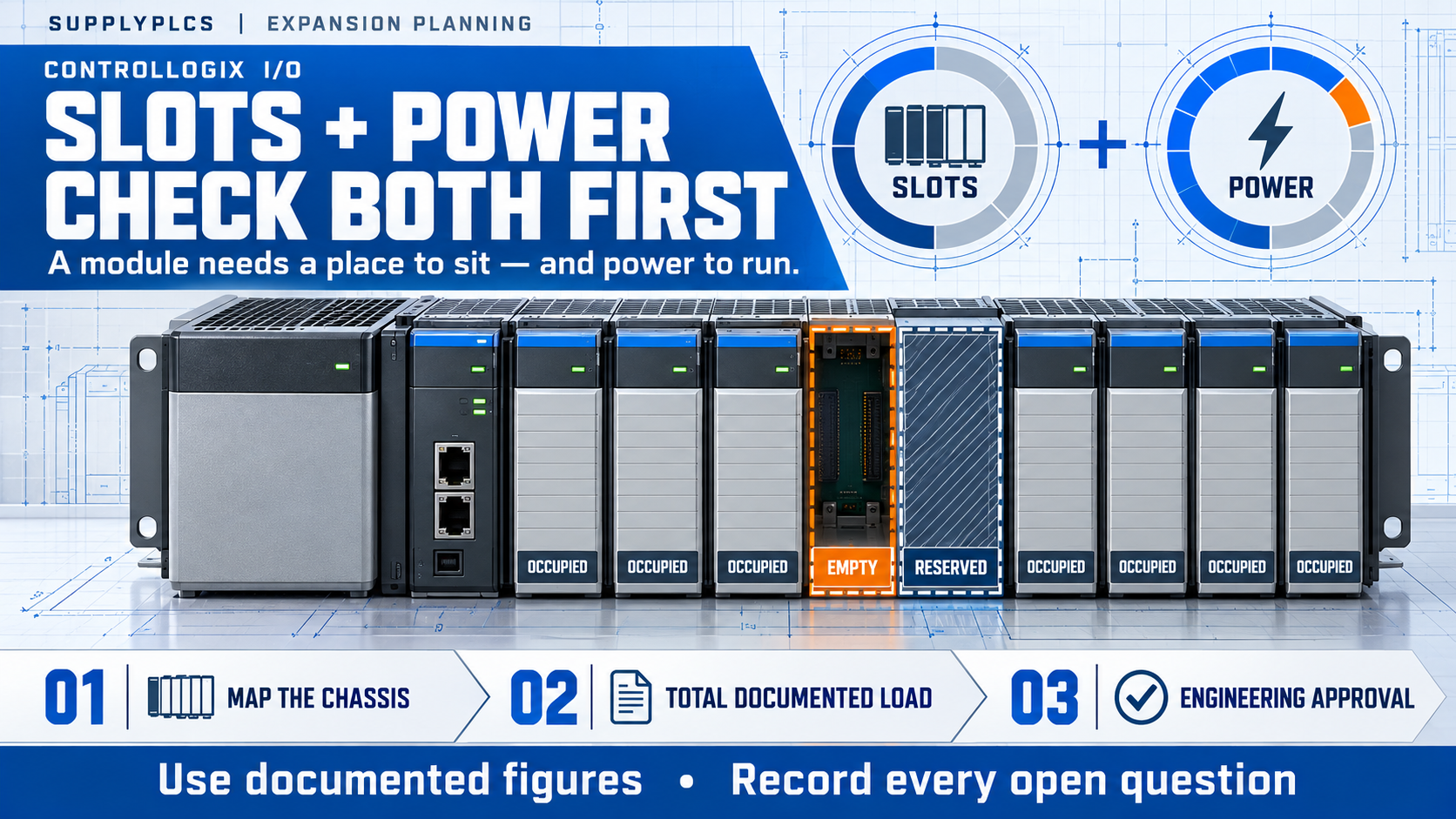
Expanding a control system is rarely as simple as adding one more card to a rack. When engineers plan ControlLogix I/O expansion, they are really planning a change to a chassis, a change that must respect both the physical space available and the power the installation can supply. The phrase ControlLogix chassis power supply I/O expansion conveniently gathers these two questions into one, but they deserve to be answered separately, because a module that fits can still be unwise to install if the power arrangement cannot carry it.
This article is written for industrial automation engineers and procurement staff who need to prepare a ControlLogix chassis power supply I/O expansion for review. It explains how to read a chassis, how to count the slots that are genuinely available, how to approach the power question using documentation, and how to document the whole exercise so that the responsible engineers can decide. It does not promise any specification, compatibility, or availability, and it treats every figure as something to be read from documentation rather than assumed.
A disciplined ControlLogix chassis power supply I/O expansion plan starts with drawings and records, not with a catalog page. The sections below set out the checks worth making, in an order that tends to produce the fewest surprises.
Why Slots and Power Are Checked Before Anything Else
A module needs two things to be added safely: a place to sit and a share of the power that is available. Neither is negotiable. For a ControlLogix chassis power supply I/O expansion, both conditions must be satisfied before a module is even considered, because a shortfall in either will surface at the worst possible moment.
Checking early also avoids wasted effort. A plan that is prepared from documentation can be reviewed calmly at a desk, while one that is discovered during a shutdown has to be solved under pressure. The cost of a desk review is small; the cost of a surprise is not.
As a rule, the earlier a constraint is discovered, the cheaper it is to accommodate. A shortage of slots found in the planning stage may be solved by rearranging modules or by choosing a different position; the same shortage found during a shutdown may force a hurried compromise. Working from documentation turns a potential emergency into an ordinary planning question.
Slots and power are the two gates through which any expansion must pass. Every ControlLogix chassis power supply I/O expansion should clear those gates before money is committed, and the way to clear them is to gather the facts first.
Reading the Chassis and Counting Available Slots
Start by identifying the chassis itself and understanding how its slots are used. The documentation for the chassis describes how many positions it provides, and the records for the installation show which of those positions are occupied. In a ControlLogix chassis power supply I/O expansion, the free slots determine what is even possible, so this count comes before any discussion of which module to buy.
Some positions may be reserved for reasons that are not obvious from a glance. A ControlLogix chassis power supply I/O expansion should note any slot that is set aside, whether because of a rule in the documentation, a convention in the plant, or a future plan that has already been agreed. Treating a reserved slot as free is an easy mistake and an avoidable one.
Record the result in a form others can read. For a ControlLogix chassis power supply I/O expansion, a simple table showing each slot, what occupies it, and what is free is more useful than a paragraph of prose, because it lets a reviewer see the layout at once. Accurate counts come from documentation and inspection, never from memory.
It is also worth checking how positions relate to one another. Some modules may need to sit in particular locations because of how they are wired or how they interact with the rest of the chassis, and those relationships may not be obvious from a simple count. Noting them in the slot map prevents a proposal that looks valid on paper but is awkward in practice.
Assessing Power Supply Capacity
Power is the second gate, and it is often the one that decides the outcome. A ControlLogix chassis power supply I/O expansion cannot be judged without knowing how much capacity the arrangement makes available and how much the installed modules are documented to draw. Those figures belong to the documentation for the specific equipment, and they should be gathered rather than estimated.
The comparison itself is arithmetic, but the inputs must be trustworthy. A ControlLogix chassis power supply I/O expansion review should rely on documented figures for each module and for the power arrangement, and should leave any judgement about margin to the responsible engineers. The buyer's task is to supply the numbers, not to interpret them.
It is also wise to leave room for the unexpected. Any ControlLogix chassis power supply I/O expansion should be referred to engineering rather than approved on the basis of a rough calculation, because a system planned too tightly can be difficult to change later. The purpose of the exercise is to inform a decision, not to replace it.
Where the documentation is ambiguous, the ambiguity should be written down rather than smoothed over. A reviewer who receives a clear list of open questions can resolve them quickly; a reviewer who receives a tidy but incomplete summary may not notice the gap until later. Honest documentation is more useful than confident documentation.
Anonymous Scenario Example
Illustrative anonymous scenario, not a Supplyplcs customer project.
In March 2024, an engineering team at a process plant in Monterrey, Mexico was asked to add several I/O modules to an existing control rack. The request arrived as a simple list of part numbers, but the team recognized it as a ControlLogix chassis power supply I/O expansion problem and started from the chassis documentation rather than from the list.
First, the team photographed the rack and wrote down which slots were occupied, which were empty, and which were reserved. Next, they collected the documented power figures for the installed modules and for the power arrangement, and passed the resulting table to the plant's responsible engineer for review. Nothing was ordered until that review was complete.
The team did not attempt to decide on its own whether the ControlLogix chassis power supply I/O expansion should proceed. Instead, they prepared the facts and asked the questions. That division of labour is what made the exercise useful: the buyer gathered information, and the engineer made the call.
Documenting the Expansion for Engineering Review
A review is only as good as the dossier behind it. A ControlLogix chassis power supply I/O expansion folder should include the chassis identification, the slot map, the documented power figures, the proposed module list, and a note of any open questions. Assembled this way, the folder lets a reviewer work quickly and consistently.
The reviewer needs to see both the facts and their sources. A ControlLogix chassis power supply I/O expansion should be approved by the responsible engineering staff, and their approval is easier to give when each figure can be traced to a document. Unexplained numbers invite doubt; sourced numbers invite confidence.
Keep the folder in a place the next person can find. A well-organized record that nobody can locate is worth little, so it is sensible to store the documents where the maintenance and purchasing teams both expect to find them. That small piece of housekeeping is what turns a one-off exercise into a reusable reference.
Documentation also supports the next change. When a future request arrives, the folder from the previous exercise becomes a starting point, saving the effort of rediscovering the chassis layout and the power situation. Records compound in value over the life of a plant.
Preparing a Spare Parts Inquiry
When the technical review is complete and a module is needed, the inquiry should carry the same precision as the review. For a ControlLogix chassis power supply I/O expansion, that means the complete module numbers, the chassis details, and a short note describing the intended position. Complete information makes a quotation request easier to answer accurately.
Supplyplcs is an industrial automation spare parts supplier, and buyers working on a ControlLogix chassis power supply I/O expansion can submit a complete model number together with clear photographs to request a quotation. All commercial terms, including price, availability, delivery, and any warranty wording, should be verified through the quotation and the order confirmation rather than assumed. Related items can be browsed on the Allen Bradley ContrlLogix category page, and the wider catalogue is available from Supplyplcs.
It helps to keep a copy of what was sent. A record of the request for a ControlLogix chassis power supply I/O expansion makes a repeat order faster and gives a colleague the context needed to repeat the process. The same discipline that makes the first request clear makes the second one routine.
The same care applies to photographs. Images of the chassis, the nameplates, and the module labels give a supplier context that a part number alone cannot, and they help confirm that the request matches the equipment in service. Good photographs are inexpensive to take and often save a round of questions.

Checklist
Use this checklist before ordering. Each item should be confirmed from documentation and inspection, and any open point should be referred to the responsible engineering staff.
- Have you identified the chassis and the number of positions it provides?
- Have you recorded which slots are occupied, empty, or reserved?
- Have you captured the documented power figures for the installed modules and the power arrangement?
- Have you listed the proposed modules and their complete model numbers?
- Have you prepared a slot map and a power summary for engineering review?
- Have you noted every open question rather than resolving it by assumption?
- Have you confirmed who is responsible for approving the expansion?
- Have you avoided promising any specification, compatibility, or availability?
- Have you prepared clear photographs of the rack and its markings?
- Have you planned to verify all commercial terms through the quotation and order confirmation?
Conclusion
A ControlLogix chassis power supply I/O expansion is a small engineering project, not a shopping decision. Slots and power are the two questions that must be answered first, and both are answered from documentation rather than from memory. A module that clears those gates deserves consideration; one that does not should not be ordered.
The division of labour matters as much as the checks. Buyers gather facts, photographs, and numbers; the responsible engineers decide whether the change may proceed. Keeping that boundary clear protects the plant and gives the review a sound basis.
Handled that way, expansion becomes a predictable, well-documented exercise. Count the slots, gather the power figures, document the proposal, and let the accountable people approve. That sequence keeps a ControlLogix chassis power supply I/O expansion safe, reviewable, and easy to repeat.