 EN

CONTROLLER / ARCHITECTURE / INTEGRATION
The controller at the centre of the safety system
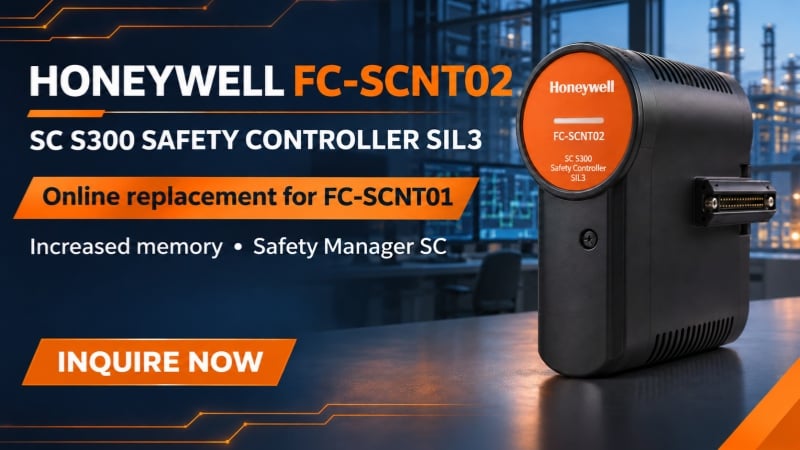
Honeywell FC-SCNT02 is an S300 safety controller module for Safety Manager SC. Its importance comes from three connected roles: occupying the safety-control layer between field I/O and protective action, providing a compatible controller replacement path for installed systems, and enabling DNP3 outstation integration on supported releases. Understanding these roles explains why it is a key component of the architecture rather than simply another module in the cabinet.
The control layer turns field information into a safety decision
Safety Manager SC combines the S300 processor with safety I/O and engineering facilities. Within that arrangement, FC-SCNT02 occupies the controller layer. The field interface and the control layer solve different problems: I/O connects the system to signals, while the configured logic determines how those signals relate to the required protective response. This is the architectural reason the controller matters.
Follow a conceptual shutdown path: a field condition reaches the safety input interface, the configured logic evaluates the condition, and the output interface communicates the resulting action to the final element. The controller sits at the decision-making stage of that path. For example, an engineered shutdown application must relate an input condition to the appropriate output response; acquiring a signal alone does not define that relationship. This example explains the functional separation, not a specific FC-SCNT02 program or wiring arrangement.
Field sensing → Safety I/O → S300 control logic → Safety I/O → Final element
Conceptual functional path, not a wiring diagram. Actual connections and safety behaviour depend on the engineered application.
Four layers with different responsibilities
| Layer | Role in the architecture |
|---|---|
| FC-SCNT02 / S300 | Controller hardware within Safety Manager SC; distinct from the field-interface modules. |
| Safety I/O | Connects the system to field signals. Universal Safety I/O supports individually configured AI, AO, DI or DO channels; this is an I/O capability, not a set of built-in FC-SCNT02 terminals. |
| Safety Builder | Provides engineering and maintenance tools. Its software release must be considered separately from controller and I/O firmware. |
| Supervisory integration | Connects safety-system information to the wider control environment. A communication connection does not replace the safety logic or field protection chain. |
A key controller within a fault-tolerant system
Safety Manager SC uses a multi-fault-tolerant QMR, or 2oo4D, architecture. FC-SCNT02 must be understood within this system arrangement: the controller layer works with the configured I/O and application rather than providing a complete safety function on its own. Its central position in the logic path makes controller configuration and compatibility consequential to the overall system design.
The distinction also matters for SIL claims. Safety Manager SC is certified for applications up to SIL 3. Selecting a SIL 3 controller does not, by itself, establish the integrity of a complete installed safety function. The sensor, logic, final element and application lifecycle must be evaluated as a complete chain.
Engineering connects controller hardware to the intended behaviour
Honeywell's R212.1 material distinguishes Safety Builder from controller and I/O firmware. It also describes a separately ordered Cause & Effect validation tool that compares imported diagrams against loaded logic on a real or virtual controller. This illustrates the difference between having the correct controller module and checking the intended application behaviour.
Later R214.1 documentation continues to identify engineering software and controller/I/O firmware as separate components. Consequently, a historical minimum release should not be presented as a recommendation for a current project. Establish the supported software combination for the actual system before deciding how a spare controller will be deployed.
A replacement path that supports installed-system continuity
FC-SCNT02 succeeds FC-SCNT01 with increased memory. Honeywell identifies it as a pin-to-pin, backward-compatible replacement with the same controller function. It can also operate with FC-SCNT01 in a redundant Safety Manager SC controller arrangement. These capabilities give FC-SCNT02 a second kind of importance: it provides a controller replacement path for systems built around FC-SCNT01. Pin compatibility addresses the hardware connection, while the documented mixed-controller arrangement is relevant to redundant-system maintenance planning. Neither capability removes the need to verify the actual application and release combination.
Hardware support begins with Safety Manager SC R200.2. Honeywell also describes online replacement capability. Neither statement is a universal instruction to exchange hardware in an operating plant: verify the installed release, redundancy condition and applicable maintenance procedure before planning the work.
DNP3 extends access to safety-system information
DNP3 outstation support was introduced with R212 and requires FC-SCNT02. Safety Manager SC occupies the outstation role; an Experion Server or ControlEdge RTU can provide the master role. The feature is licensed in Safety Builder. A supported controller alone is therefore not sufficient evidence that a particular installation is ready to use DNP3.
This gives the module a role beyond replacement compatibility: FC-SCNT02 is the required controller hardware for this documented communication capability. The distinction is practical. A project seeking DNP3 outstation integration must consider the controller, software release and license together. R200.2 establishes the stated hardware-support boundary; it does not establish DNP3 availability. Increased memory is a documented change, but no numerical capacity or resulting execution-speed improvement is asserted here.
Why FC-SCNT02 is a key module: three architectural reasons
- Safety-control position: it occupies the controller layer in the path from field information to the configured protective response.
- Installed-system continuity: backward compatibility and the documented FC-SCNT01 replacement options support maintenance and controller migration planning.
- Communication capability: it supplies the controller hardware required for DNP3 outstation operation when the supported release and license are present.
FC-SCNT02 is therefore key for both the operating architecture and the lifecycle of an installed Safety Manager SC system. It belongs at the logic stage of the safety chain, offers a documented route from earlier controller hardware, and enables a release-dependent communication option. These are distinct contributions, not a claim that one module alone delivers a complete SIL 3 safety function. Its significance becomes clear only when controller hardware, field I/O, application engineering and system integration are considered together.
Honeywell reference documents
- Safety Manager SC: platform architecture and safety I/O
- August 2022 System HINTS: FC-SCNT02 introduction and compatibility
- 2023 Q2 technical update: replacement and DNP3 requirements
- January 2023 System HINTS: R212.1 engineering components and validation
- December 2025 System HINTS: R214.1 software components
Release references describe specific documented capabilities; confirm applicability to the installed system.
LET'S DISCUSS YOUR REQUIREMENT
Contact Jim Pei
For FC-SCNT02 enquiries, share the required quantity and your installed system details.
Sales manager: Jim Pei
Email: [email protected]
Wechat: ZXH18020776782
Phone/WhatsApp: +86 18020776782
Table of Contents
- The controller at the centre of the safety system
- The control layer turns field information into a safety decision
- Four layers with different responsibilities
- A key controller within a fault-tolerant system
- Engineering connects controller hardware to the intended behaviour
- A replacement path that supports installed-system continuity
- DNP3 extends access to safety-system information
- Why FC-SCNT02 is a key module: three architectural reasons
- Honeywell reference documents
- Contact Jim Pei