Industrial Automation System Guide
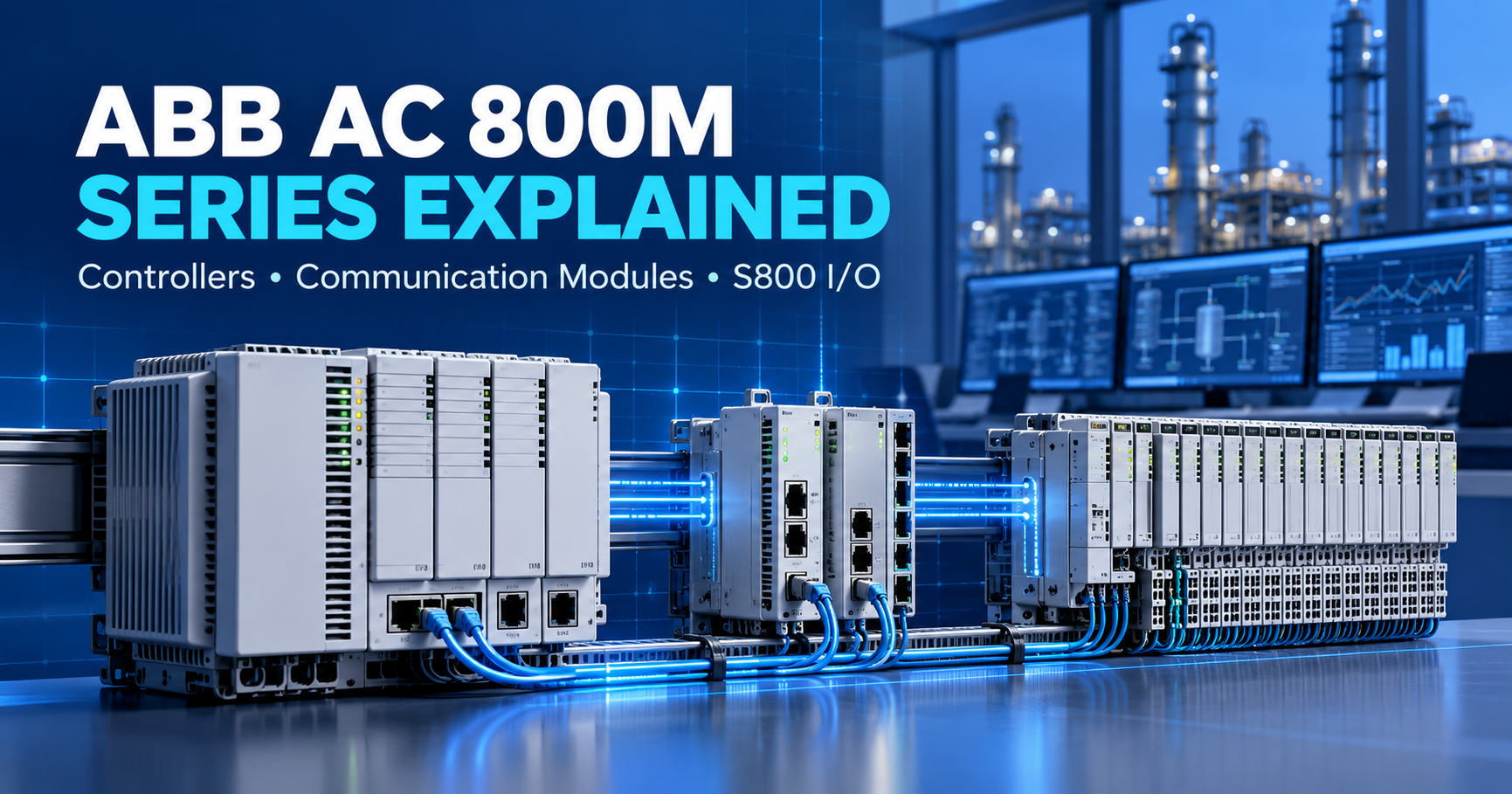
ABB AC 800M is a modular controller platform used in process automation, power, water, oil and gas, chemical production, marine applications, and other operations where dependable control and clear diagnostics matter. Understanding the relationship between the controller, communication interfaces, and S800 I/O is essential before selecting a spare, planning an expansion, or replacing an installed module.
AC 800M is a family of rail-mounted controllers designed to work as part of ABB automation environments, including System 800xA installations. Its modular structure allows an engineering team to combine a processor unit with the communication modules, power arrangements, local or remote I/O, and application software required by a particular plant.
The controller executes the control application, processes field information, exchanges data with operator and engineering stations, and coordinates connected devices. The processor is only one part of the complete system. Firmware, controller type, memory, redundancy design, communication protocols, I/O interfaces, baseplates, terminal units, and software compatibility all affect whether a module is suitable. A matching appearance is not proof that two AC 800M components are interchangeable.
The PM8xx processor family covers projects ranging from compact control applications to larger systems that require more capacity, communication resources, or redundancy. Commonly encountered models include PM851, PM856, PM861, PM864, PM866, and PM867. The correct choice depends on the existing project rather than on processor performance alone.
For an installed system, record the complete model designation, product identity, hardware revision, firmware level, controller baseplate, memory or licensing requirements, and the software version used to engineer the project. In a redundant configuration, confirm the partner controller, synchronization arrangement, firmware alignment, and approved replacement procedure. Mixing revisions without checking the relevant ABB documentation may prevent commissioning or create an unsupported configuration.
A controller replacement should begin with a verified backup of the application and configuration. The maintenance team should also document IP settings, node addresses, communication links, I/O mappings, and any safety-related dependencies. These details reduce the risk of turning a straightforward hardware replacement into an extended shutdown.
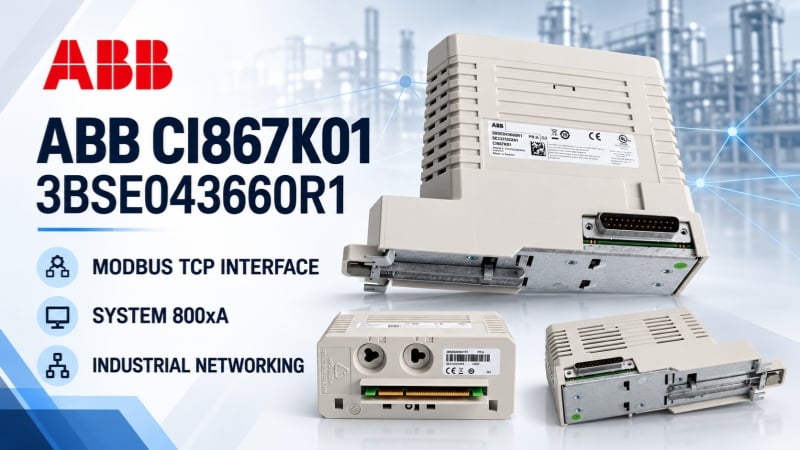
Communication modules allow the AC 800M controller to connect with field networks, remote I/O, drives, protection equipment, third-party controllers, and plant information systems. Frequently used interfaces include CI854B for PROFIBUS DP communication, CI867 for Modbus TCP, CI868 for IEC 61850, CI871 for PROFINET IO, and CI873 for EtherNet/IP. The correct module depends on the protocol, network topology, device roles, engineering library, and supported system version.
When replacing a communication interface, do not verify only the visible model name. Check the full product code, hardware revision, firmware, controller compatibility, configured protocol role, network address, cable and connector type, redundancy requirements, and the number and type of connected devices. Existing configuration files and screenshots of network parameters can be valuable when a failed module can no longer be read online.
Network performance also depends on engineering choices outside the module itself. Segment loading, update time, grounding, termination, switch configuration, time synchronization, cybersecurity controls, and qualified device files should be reviewed before commissioning. Use the applicable ABB manuals and compatibility documentation for the exact system release.
S800 I/O is a modular distributed I/O system that connects field signals to the control platform. It can be installed close to process equipment to reduce field cabling and can support a broad mix of analog, digital, pulse, temperature, and specialized signal types. A typical station combines a field communication interface, module termination units, I/O modules, power components, and the required network connection.
Examples often found in industrial plants include AI810 or AI815 analog input modules, AO810V2 analog output modules, DI810 digital input modules, and DO810 digital output modules. Communication interfaces such as CI801 or CI840A may be used in S800 I/O arrangements depending on the network and redundancy design. The exact module and termination unit combination must be confirmed because channel count alone does not establish compatibility.
Before ordering an S800 I/O spare, record the signal type, channel count, voltage or current range, isolation needs, hazardous-area or safety requirements, termination unit model, communication interface, and installed revision. Photograph both the front label and the base or termination hardware. A module may fit mechanically while having a different electrical function or approval.
For a new expansion, begin with the process requirements: number and type of signals, scan and response expectations, communications, availability target, environmental conditions, cabinet space, power, and future growth. From there, define the controller capacity, redundancy level, communication interfaces, and S800 I/O station layout.
For a replacement project, the safest starting point is the installed configuration. Compare the complete product identity and review the engineering environment before considering a newer model. A successor may require a different baseplate, firmware, library, project conversion, communication setting, or commissioning procedure. Planned migration and emergency spare replacement are different tasks and should not use the same assumptions.
The following models are common reference points for AC 800M and S800 I/O projects. They are recommendations for evaluation, not automatic substitutes. Final selection must be checked against the installed system and current manufacturer documentation.
| Model | Category | Typical Reason to Review | Confirm Before Ordering |
|---|---|---|---|
| PM861 / PM861A | Controller | Installed AC 800M spare or maintenance requirement | Full code, revision, firmware, baseplate |
| PM864 / PM864A | Controller | Higher-capacity or redundant system evaluation | Partner CPU, synchronization, software release |
| PM866 / PM867 | Controller | Large or demanding control applications | Capacity, licensing, redundancy and lifecycle |
| CI854B | Communication | PROFIBUS DP network integration | Network design, firmware and device configuration |
| CI867 | Communication | Modbus TCP connectivity | Client/server role, IP plan and software support |
| CI871 | Communication | PROFINET IO connection | Supported devices, topology and system version |
| AI810 / AI815 | S800 I/O | Analog input expansion or replacement | Signal range, isolation, MTU and channel wiring |
| DI810 / DO810 | S800 I/O | Digital signal expansion or replacement | Voltage, channel arrangement, MTU and field load |
| CI840A | S800 Interface | Remote I/O and redundant interface evaluation | Network, base hardware, firmware and redundancy |
Send the complete part number, quantity, condition requirement, destination, and clear nameplate photos. We can help review stock information and the items that should be checked before procurement.
Email: [email protected]
WhatsApp: +86 18159889985
Product names and trademarks belong to their respective owners. Configuration and replacement decisions should be verified by qualified personnel using the documentation applicable to the exact hardware and software revision.
 EN