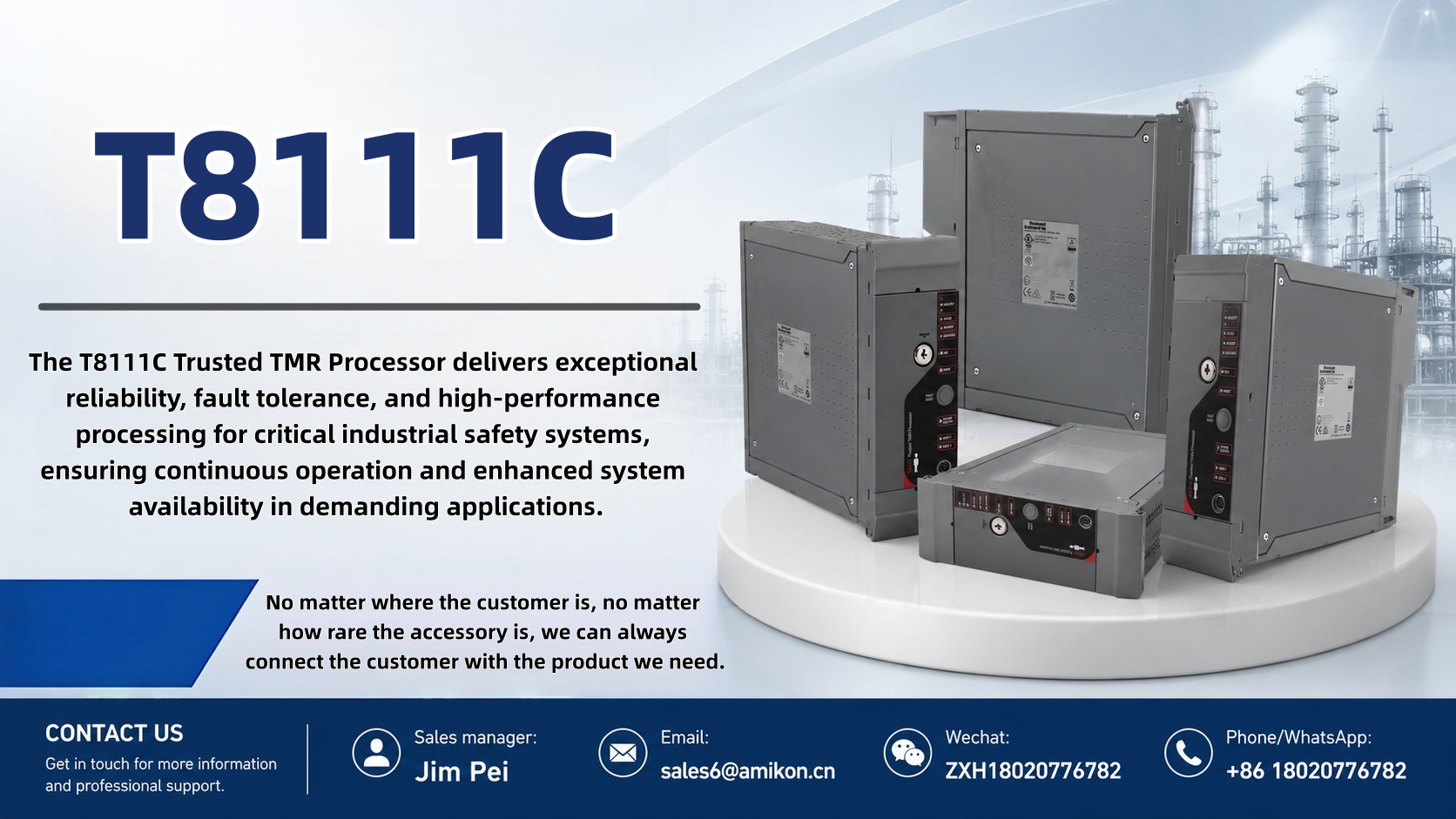
As industrial automation continues to evolve, industries such as oil and gas, petrochemicals, power generation, metallurgy, and transportation are placing greater emphasis on operational safety and system reliability. Industrial Safety Instrumented Systems (SIS) have become a critical component in protecting personnel, equipment, and production processes. At the heart of these systems, the T8111C Processor serves as a reliable processing unit capable of supporting mission-critical control tasks with high availability and dependable performance.
For enterprises operating continuous production facilities, selecting a high-performance industrial safety processor is not only essential for minimizing unexpected downtime but also for improving operational efficiency and ensuring compliance with increasingly stringent safety standards.
In recent years, with the rapid advancement of intelligent manufacturing and digital factory construction, industrial control systems have gradually evolved from traditional automation towards intelligence and high availability. At the same time, the scale of production facilities is constantly expanding, and once a control system malfunctions, it may cause equipment downtime, production interruption, or even safety accidents.
Therefore, more and more industrial enterprises are beginning to adopt safety control platforms with high availability designs to meet the requirements of continuous operation and fault tolerance. As a crucial component of safety control systems, the T8111C Processor handles logic operations, data processing, and safety control tasks, providing stable and reliable core computing power for the entire control system.
Especially in continuous production industries such as oil and gas, refining, chemicals, and power generation, highly reliable processors have become a vital foundation for ensuring the long-term stable operation of equipment.
The T8111C Processor is engineered to meet the demanding operational requirements of industrial safety environments. Unlike conventional industrial controllers, it is designed with an emphasis on reliability, fault tolerance, and long-term operational stability.
Its primary advantages include:
High-reliability architecture designed for critical industrial control applications.
Fast processing performance capable of handling complex safety logic.
Compatibility with Safety Instrumented Systems (SIS) and mission-critical automation platforms.
Support for online diagnostics and maintenance to reduce service interruptions.
Flexible integration with various industrial control modules for scalable system design.
These features enable industrial facilities to reduce unscheduled downtime while improving maintenance efficiency and maximizing system availability.
In addition, advanced diagnostic capabilities help maintenance personnel quickly identify abnormal operating conditions, minimizing troubleshooting time and enhancing overall operational reliability.
With its stable operating performance, the T8111C Processor has been widely applied in multiple industrial sectors.
In the oil and gas industry, it can be used for the safety control of critical equipment such as oil pipelines, natural gas processing units, and offshore platforms, ensuring stable operation of the production process.
In the chemical industry, facing complex operating conditions such as high temperature, high pressure, and flammable and explosive environments, safety control systems require continuous monitoring of the on-site operating status. The T8111C Processor can quickly respond to control logic, improve system reliability, and provide technical support for production safety.
Furthermore, in the thermal power generation, nuclear power auxiliary systems, water treatment, and metallurgical industries, this processor can also meet the requirements of critical control systems for high reliability and continuous operation, helping enterprises improve their overall automation level.
As industrial digital transformation continues to deepen, its application scope is further expanding, providing reliable safety control solutions for more industries.
Modern manufacturers are increasingly focused on lifecycle asset management, operational efficiency, and predictive maintenance strategies. Stable safety control systems play an essential role in achieving these objectives.
Implementing the T8111C Processor within industrial safety architectures provides several operational benefits.
First, improved system availability helps reduce unexpected shutdowns caused by controller failures, allowing production facilities to maintain continuous operation.
Second, enhanced process reliability minimizes operational disruptions, improving overall plant productivity while reducing maintenance costs associated with emergency repairs.
Third, it improves system diagnostic capabilities, helping maintenance personnel quickly locate faults, increasing repair efficiency, and shortening maintenance time.
Furthermore, a stable control platform helps enterprises meet safety production standards and provides more reliable infrastructure support for digital factory construction.
For industrial enterprises seeking long-term stable operation, a high-reliability processor is not only a technological investment but also a crucial component for enhancing core competitiveness.
With the continuous development of the Industrial Internet, artificial intelligence, big data analytics, and intelligent operation and maintenance technologies, future industrial safety systems will become more intelligent and networked.
The next generation of industrial control platforms not only needs powerful data processing capabilities but also must support functions such as remote monitoring, predictive maintenance, and equipment health management.
In the future, high-reliability processors will continue to develop in the following directions:
Higher system availability and fault tolerance;
Faster data processing speeds and control response capabilities;
More robust network security protection capabilities;
More flexible system scalability;
More efficient intelligent diagnostics and remote maintenance capabilities.
These development trends will further drive the upgrade of industrial automation towards intelligent manufacturing, creating higher production value for enterprises.
Faced with increasingly complex industrial production environments, enterprises' requirements for security control systems have upgraded from "being able to operate" to "long-term stability, security, reliability, and ease of maintenance." The T8111C Processor, with its mature industrial control technology, high-reliability operation capabilities, and broad industry applicability, provides a stable core processing platform for industrial security systems.
In the future, with the continuous advancement of intelligent manufacturing and industrial digitalization, high-reliability security processors will play an even more important role in the field of industrial control. For companies looking to improve production safety, optimize system reliability, and enhance operational efficiency, choosing processors with stable performance suitable for critical control scenarios will be a crucial support for driving industrial automation upgrades and will lay a solid foundation for building a safer, more efficient, and sustainable production system.
If you would like to learn more about this product, please feel free to contact us. Our team will be happy to answer your questions and provide professional support
Sales manager:Jim Pei
Wechat: ZXH18020776782
 EN
EN