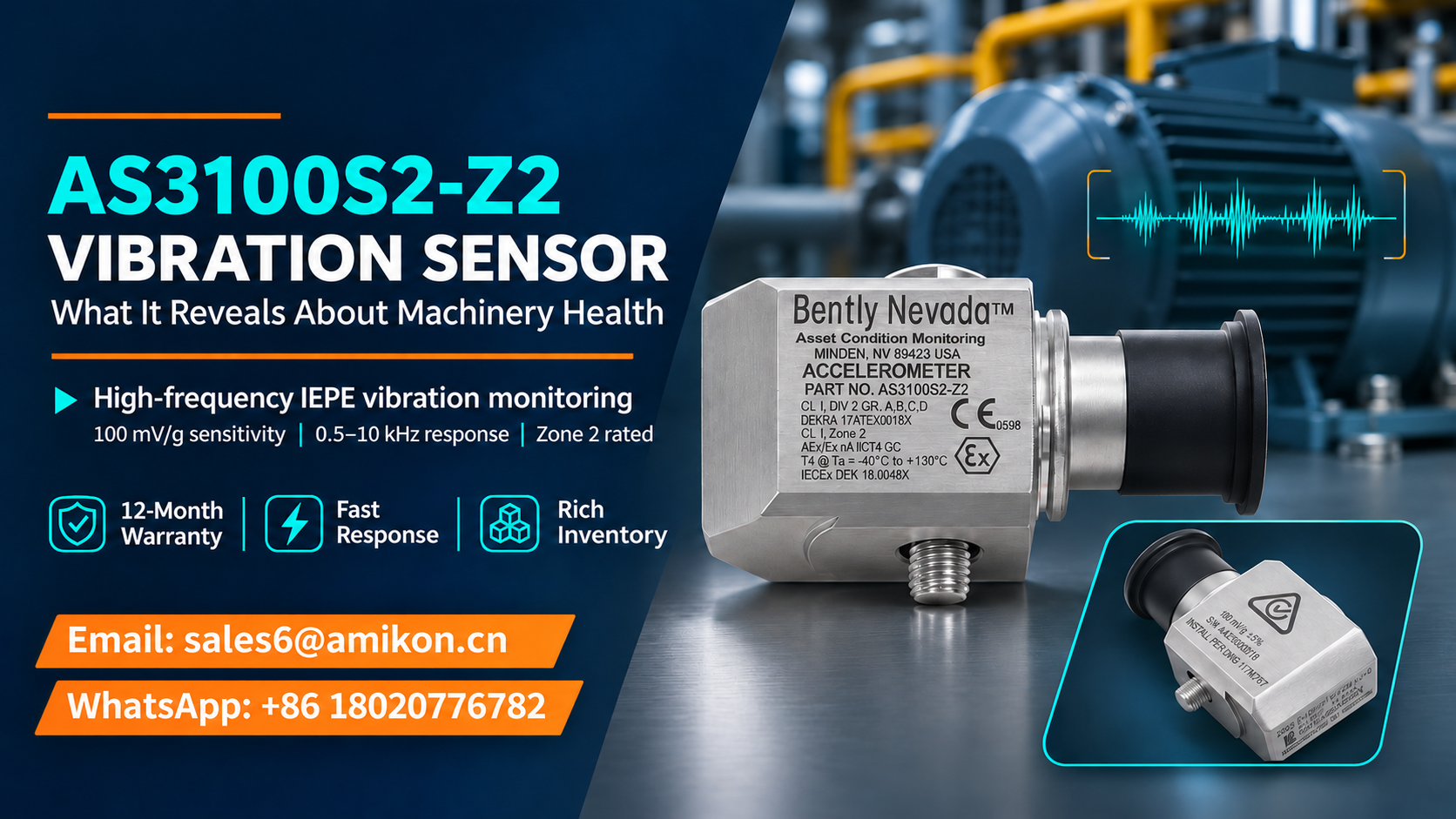
AS3100S2-Z2 is a side-exit IEPE vibration sensor designed to capture the acceleration signals that reveal changes in machine behavior. With a 100 mV/g sensitivity, an 80 g peak acceleration range and a usable frequency response extending to 10 kHz, it gives condition-monitoring teams a practical signal for tracking machinery health.
Rotating equipment rarely fails without changing its vibration pattern first. A stable machine produces a repeatable acceleration signature; imbalance, looseness, resonance, rubbing or bearing distress can shift the amplitude or introduce new frequency content. The AS3100S2-Z2 converts those mechanical movements into an IEPE output so technicians can compare a baseline with later readings, follow developing trends and plan inspection before a small change becomes an unplanned stoppage.
The sensor uses a PZT ceramic shear element and a hermetically sealed 316L stainless-steel case. Its side-exit, two-pin MIL-C-5015-style connector and isolated, internally shielded case support clean signal routing in demanding industrial environments. The Zone 2-rated configuration is intended for installations where robust vibration measurement and hazardous-area suitability must be considered together.
For a meaningful comparison, readings should be collected at repeatable speed, load and measurement points. A rising broadband level or a new narrow-band peak is a reason to verify mounting, coupling, balance, alignment and lubrication before assigning a root cause.
The combination of sensitivity, bandwidth, environmental limits and low output impedance helps the monitoring system preserve useful vibration detail from the machine housing to the analysis instrument.
Acceleration records the rapid motion transmitted through a machine housing. With a 0.5–10,000 Hz response at ±3 dB and 100 mV/g sensitivity, the AS3100S2-Z2 provides a repeatable signal for comparing overall movement and changes in frequency content. The sensor supplies the measurement; maintenance decisions still depend on the machine baseline, operating condition and engineering review.
Acceleration is especially useful when a machine’s higher-frequency content changes before overall displacement becomes obvious. Comparing the same sensor location over time helps separate a real trend from a one-off operating change; final diagnosis still requires engineering review and corroborating data.
| Mechanical input | Machine housing motion reaches the sensor through the 1/4-28 UNF mounting point. |
| Sensing element | A PZT ceramic shear element converts acceleration into an IEPE output. |
| Power and transmission | The monitoring channel provides 18–30 VDC and 2–10 mA, then receives the signal through the side-exit two-pin connector and shielded twisted pair. |
| Condition assessment | Engineers compare the measured amplitude and frequency content with a known operating baseline. |
At the acquisition stage, use an IEPE-compatible constant-current input to provide the specified excitation and couple the AC vibration signal into the monitoring channel.
| Parameter | AS3100S2-Z2 value | Parameter | AS3100S2-Z2 value |
|---|---|---|---|
| Sensor type | IEPE acceleration sensor | Cable exit | Side exit |
| Sensitivity at 25°C | 100 mV/g ±5% | Acceleration range | 80 g peak |
| Amplitude nonlinearity | 1% | Frequency response, ±10% | 1.0–5,000 Hz |
| Frequency response, ±3 dB | 0.5–10,000 Hz | Resonant frequency | 22 kHz |
| Transverse sensitivity | ±5% of axial, maximum | Voltage source | 18–30 VDC |
| Current regulating diode | 2–10 mA | Broadband electrical noise | 700 µg at 2.5 Hz–25 kHz |
| Spectral noise at 10 Hz | 10 µg/√Hz | Spectral noise at 100 Hz | 5 µg/√Hz |
| Spectral noise at 1,000 Hz | 5 µg/√Hz | Output impedance | 100 Ω maximum |
| Bias output voltage | 12 VDC | Operating temperature | −55°C to 120°C |
| Vibration limit | 500 g peak | Shock limit | 5,000 g peak |
| Electromagnetic sensitivity | 70 µg/gauss maximum | Sealing | Hermetic |
| Sensing element | PZT ceramic / shear | Case material | 316L stainless steel |
| Mounting | 1/4-28 UNF tapped hole | Connector | 2-pin, MIL-C-5015 style |
| Recommended cable | Shielded twisted pair, no longer than 100 ft | Connector pin A | Power / signal |
| Connector pin B | Common | Zone rating | Zone 2 rated |
Mount the sensor securely on the machine housing, use the specified constant-current supply and route a shielded twisted-pair cable to the monitoring input. Compare readings under a known operating condition, then trend changes in overall amplitude and frequency content. The most useful result is not one isolated number but a repeatable history that helps the maintenance team decide when to inspect, balance, align, lubricate or schedule a controlled shutdown.
For replacement planning, verify the mounting thread, connector style, side-exit orientation, excitation range and hazardous-area requirements before ordering. These checks keep the sensor, cable and monitoring channel matched to the installed system.
During a campaign, keep the sensor location, cable path, speed and load context consistent. Record the operating condition with each sample so a change can be linked to a machine state rather than mistaken for sensor drift.
In a condition-monitoring program, the AS3100S2-Z2 turns machine acceleration into a repeatable IEPE signal. That signal helps maintenance teams connect vibration measurements with machinery health, predictive maintenance and a controlled inspection plan.
If a change persists, use the frequency pattern and operating context to prioritize checks: balance and alignment for running-speed changes, looseness for harmonics, or rubbing and bearing-related areas for new high-frequency content. These are inspection directions, not automatic diagnoses.
| Establish a baseline | Record the sensor output under a known machine condition so later readings have a reliable reference. |
| Compare the trend | Review changes in overall amplitude and frequency content instead of relying on one isolated measurement. |
| Plan the response | Use the evidence to schedule inspection, balancing, alignment, lubrication or a controlled shutdown with engineering review. |
What does AS3100S2-Z2 reveal about machinery health?
It provides repeatable acceleration data so engineers can compare a machine baseline with later amplitude and frequency readings. The sensor supports assessment; it does not diagnose a fault on its own.
How can a rising vibration trend guide inspection?
A change in amplitude or frequency content can prompt checks around balance, looseness, resonance, rubbing or bearing-related areas before a controlled maintenance decision is made.
What should be checked before blaming the machine?
Verify the 1/4-28 UNF mounting point, side-exit connector, shielded cable route, 18–30 VDC supply and 2–10 mA constant-current excitation first.
Can AS3100S2-Z2 support demanding installations?
Its hermetic seal, 316L stainless-steel case, −55°C to 120°C operating range, 500 g vibration limit, 5,000 g shock limit and Zone 2 rating support appropriately specified industrial installations.
| FC-TSDI-1624C | ANMA213V2 | H3-5068X03 |
| 7101063006W | SRD-91 | 225629-007 |
| INF-1001 | VAZ-2FK-G10-BRIDGE | 45-123 |
| I/P DMX | LEM-3 | MIC-1000 |
| inbio460 | WR3910-894 | 606000-40 |
| DM5240 | PCX924 | FCM10EF |
| BS207 | BS210 | P0904AK |
| P0917MF | 9150/20-11-10 | 9151/10-16-10 |
| M150/10-14-10 | 48-4103 | RS2B |
| 220614 | EXP-1048 | FW-325 |
| KL1408-0000 | UFM-D05 | REF.04813 |
| IZM-KLP-SO-RONIS | PRT-CTRL-DIN | 901-9648 |
| OBi302 | NJS8477EN | 663AA002237 |
Sales manager: Jim Pei
Email: [email protected]
Wechat: ZXH18020776782
Phone/WhatsApp: +86 18020776782
 EN