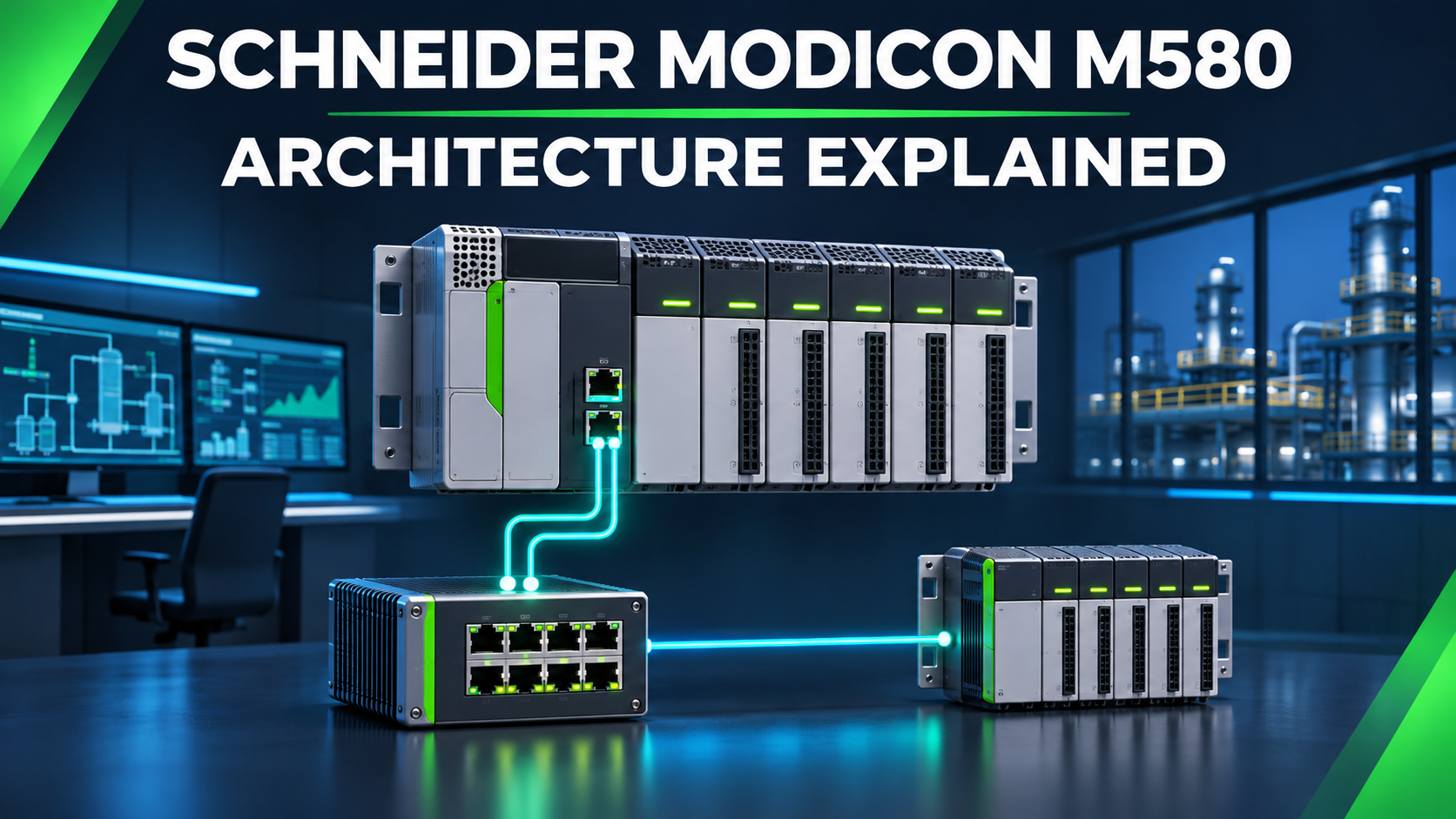
Schneider Electric Modicon M580 is an Ethernet programmable automation controller platform designed to combine control processing, local Modicon X80 I/O, Ethernet remote I/O and distributed industrial devices within one scalable architecture. Understanding how the processor, backplane, I/O drops and network modules work together is essential when designing a new system, expanding an installed rack or preparing a technically complete replacement request.
The M580 should not be treated as a collection of interchangeable modules. CPU capacity, Ethernet port type, rack bus, remote-drop adaptor, power supply, I/O wiring, firmware and EcoStruxure Control Expert version all influence compatibility. The correct configuration is the one validated for the exact application and supported by current Schneider Electric documentation.
The M580 processor resides in the local backplane and is responsible for configuring the modules in the project, executing the control application, reading inputs, updating outputs and managing explicit and implicit communications. Processor selection is based on far more than program memory. Engineers must consider the number of local racks, remote I/O drops, distributed devices, communication modules, application-specific channels, task structure and required availability.
Standalone BMEP58 processors cover different performance levels. Models ending in 20 are commonly used for local and distributed I/O architectures, while selected models ending in 40 provide the embedded remote-I/O capability required for M580 Ethernet RIO architectures. BMEH58 processors support validated Hot Standby designs. The complete catalog number, product version, firmware and Control Expert project must be checked before replacing one processor with another.
The local rack normally contains the power supply, M580 processor and the required communication, I/O or application-specific modules. All Modicon X80 racks provide X Bus connections, while BMEXBP Ethernet backplanes add an embedded Ethernet bus in supported slots. That distinction matters because eX80 modules, Ethernet communication modules and certain third-party modules require the Ethernet connection on the backplane.
A module may physically fit a slot but still be installed in the wrong bus position. On larger BMEXBP racks, not every slot necessarily provides both Ethernet and X Bus connectivity. The rack reference, slot position, module pinning and power budget therefore need to be verified from the hardware manual. Modicon X80 covers discrete I/O, analog I/O, HART, counting, motion, serial communication and other functions, but compatibility is architecture- and module-specific.
M580 can connect the local rack to Modicon X80 remote I/O drops and distributed Ethernet devices. An RIO drop uses a compatible CRA adaptor to connect the remote rack to the controller-managed Ethernet I/O network. Distributed I/O devices can include drives, instruments, HMIs or other Ethernet equipment scanned by the controller. The two device types may share a validated physical network, but they serve different roles and must follow the supported topology and performance rules.
| Architecture Point | Ethernet RIO | Distributed I/O |
|---|---|---|
| Primary role | Deterministic controller-managed remote X80 I/O | Connection of distributed Ethernet devices |
| Typical rack interface | BMECRA or BMXCRA drop adaptor | Device Ethernet interface or supported gateway |
| Topology priority | Validated RIO loop, ring or supported switched design | Supported star, ring or device-network arrangement |
| Key verification | CPU RIO capacity, CRA type, rack bus and drop numbering | Protocol, scan rate, addressing, bandwidth and device profile |
Ethernet is the backbone of the M580 platform. Depending on the processor and communication modules selected, the system can exchange data through EtherNet/IP and Modbus TCP, connect remote I/O, scan distributed devices and provide service access. Additional BMENOC communication modules extend network capacity or add specific services. Network segmentation, managed-switch configuration, device addressing, ring recovery, bandwidth and cybersecurity policies must be planned as part of the control architecture rather than added after commissioning.
A practical data path is: field device → X80 I/O module → local or remote rack → M580 CPU → control network → HMI, SCADA or plant system. Each layer has its own compatibility conditions. A replacement communication module may require a current firmware level, a supported product version and an updated project configuration even when the connectors appear identical.
For applications that require higher availability, the M580 family supports validated Hot Standby controllers and several levels of network and power redundancy. Schneider Electric documentation describes architectures that can include redundant CPUs, redundant X80 power supplies, duplicated network paths and redundant remote-I/O designs. The required availability target should be defined before selecting hardware because a standard standalone architecture cannot be converted into a fully redundant system by changing only the CPU.
Cybersecurity also depends on system configuration. Keep firmware under an approved lifecycle process, disable unused services, apply access control, separate control and enterprise networks, document every service port and follow the site's backup and change-control procedures. Product security functions do not replace a complete defense-in-depth architecture.
The following references represent common M580 and Modicon X80 hardware categories. They are not universal substitutes. Availability, lifecycle status and compatibility must be confirmed from the complete system configuration and current Schneider Electric documentation.
| Model | Hardware Type | Key Check Before Ordering |
|---|---|---|
| BMEP581020 | M580 standalone processor | Application size, local racks, DIO devices and firmware |
| BMEP582040 | M580 processor with RIO capability | RIO drops, project capacity and Control Expert support |
| BMEP584040 | Higher-capacity M580 processor | Memory, rack count, communication modules and RIO load |
| BMEP586040 | High-capacity M580 processor | Application performance, network scale and software release |
| BMEH584040 | M580 Hot Standby processor | Matched pair, redundancy design, firmware and accessories |
| BMEXBP0800 | 8-slot Ethernet and X Bus backplane | Power supply, slot allocation and module bus requirement |
| BMEXBP1200 | 12-slot Ethernet and X Bus backplane | Ethernet-capable slot positions and rack power budget |
| BMECRA31210 | Performance X80 Ethernet drop adaptor | Backplane type, drop address, topology and firmware |
| BMENOC0302 | Performance Ethernet communication module | CPU capacity, protocol services and project configuration |
| BMXDDI3202K | 32-channel 24 VDC discrete input | Input logic, connector, cordset and field voltage |
| BMXDDO3202K | 32-channel 24 VDC transistor output | Load current, output logic, connector and protection |
| BMXAMI0810 | 8-channel isolated analog input | Signal range, terminal block, loop power and wiring |
| BMXAMO0802 | 8-channel analog output | Output range, load, terminal assembly and firmware |
Send the complete nameplate photos, processor and module references, rack layout, firmware, Control Expert version, quantity, required condition and destination. Our team will review stock information, product photos and ordering details before quotation.
Email: [email protected]
WhatsApp: +86 18159889985
Schneider Electric, Modicon, EcoStruxure and related product names are trademarks of their respective owners and are used for identification and informational purposes only. Compatibility, installation, network configuration and safety decisions should be reviewed by qualified personnel using current manufacturer documentation and the site's approved procedures.
 EN