Home > Products > GE > GE VersaMax IC200
Product Name: ANLONG INPUT MODULE
Brand Name: GE
Model Number:IC200ALG620
Country of Origin:USA
Warranty: 12 Months
Whatsapp:+86 18159889985
Email:[email protected]

Brand Name: |
General Electric |
Model Number: |
IC200ALG620 |
Country of Origin: |
USA |
Packaging Details: |
Original new Factory Sealed |
Delivery Time: |
Delivery time in stock |
Payment Terms: |
T/T |
|
Sales Manager: |
Stella |
|
Send an email: |
|
|
Contact in Whatsapp: |
|
Parameter |
Specification |
|
Part Number |
IC200ALG620 |
|
Manufacturer |
GE Fanuc / Emerson Automation |
|
Product Type |
VersaMax Analog Input RTD Module |
|
Input Channels |
4 (3-wire and/or 4-wire RTDs) |
|
Sensor Compatibility |
Platinum (25/100/1000 Ω), Copper (10/50/100 Ω), Nickel (100/120 Ω), Nickel/Iron (604 Ω) |
|
Resistance Ranges |
0–500 Ω, 0–3000 Ω |
|
Resolution |
16 bits (15 bits + sign) |
|
Accuracy |
±0.15% at 25 °C |
|
Temperature Drift |
±0.004% of reading per °C |
|
Normal Mode Rejection |
60 dB at 50/60 Hz |
|
Common Mode Rejection |
120 dB at 50/60 Hz |
|
Update Rate |
210 ms/channel @ 60 Hz; 230 ms/channel @ 50 Hz |
|
Isolation (Input to Frame) |
250 VAC continuous; 1500 VAC for 1 minute |
|
Backplane Current |
125 mA @ 5V; 125 mA @ 3.3V |
|
External Power Required |
None (excitation current provided by module) |
|
Maximum Lead Resistance |
50 Ω per lead |
|
Dimensions (mm) |
Standard VersaMax module size |
|
Weight |
0.3 kg |
|
Operating Temperature |
0 °C to 60 °C |
|
Storage Temperature |
-40 °C to 85 °C |
|
Relative Humidity |
5% to 95% (non-condensing) |
|
Dimensions |
11x6x6.7cm |
|
Weight |
0.18kg |
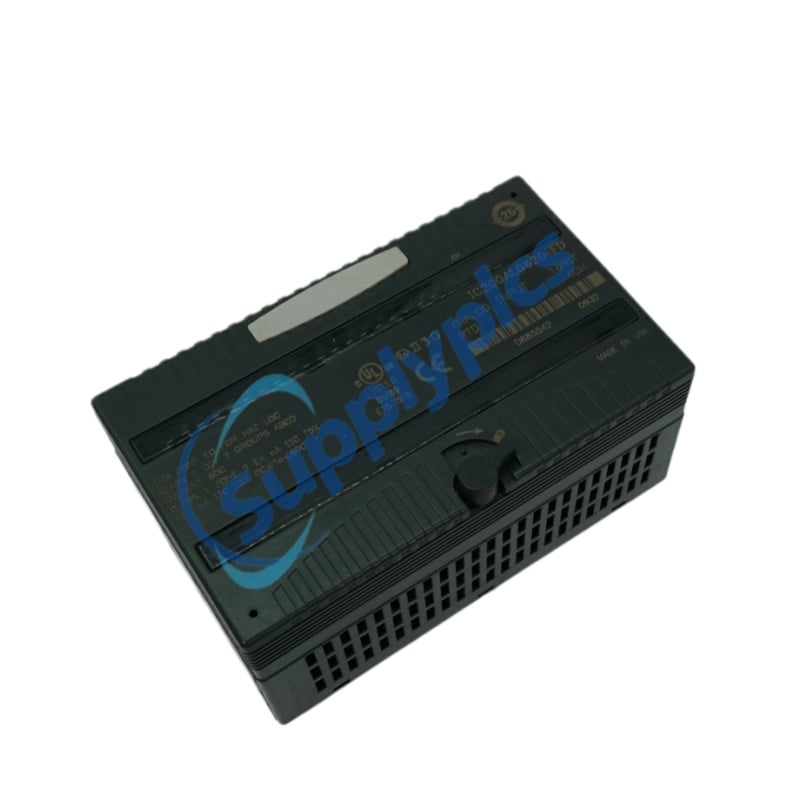
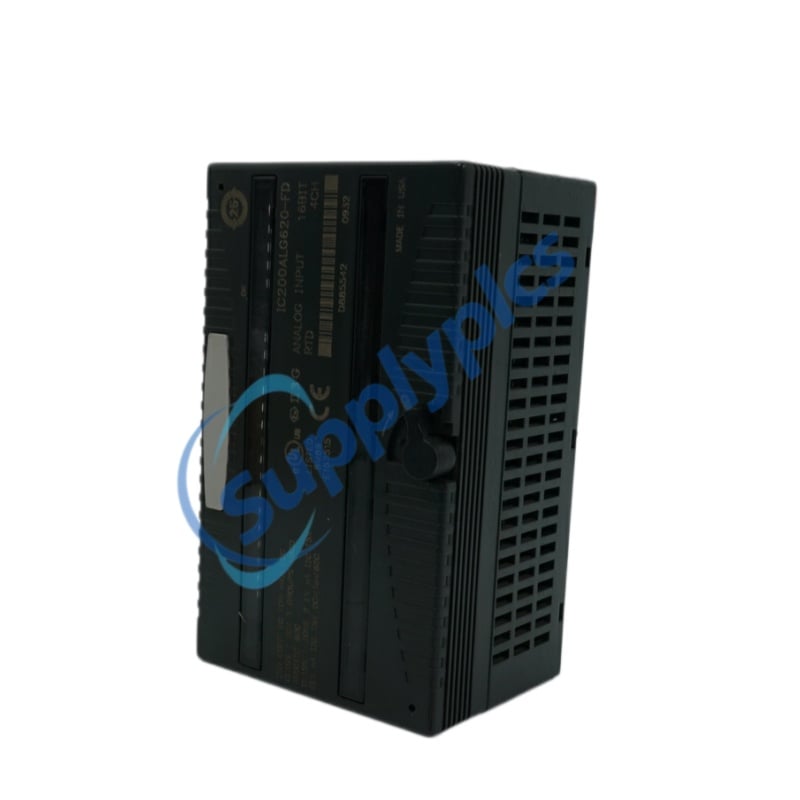
The IC200ALG620 is an intelligent analog input module within the GE Fanuc VersaMax I/O platform, specifically designed for high-precision RTD temperature measurement. This IC200ALG620 module accepts signals from up to four independent 3-wire or 4-wire RTDs, supporting platinum, nickel, nickel/iron, and copper sensor types. The IC200ALG620 provides 16‑bit resolution data and requires no external power supply, as it internally generates the excitation current for the connected sensors.
The module includes advanced diagnostic capabilities to ensure reliable operation and easy troubleshooting. The module can report a range of diagnostic conditions to the I/O Fault Table, including:
Over/Under Range: Alerts when the input signal is outside the expected range.
Open Wire: Detects if an RTD sensor is disconnected or has a broken wire.
Non-Volatile Memory Storage: Ensures critical configuration and calibration data are retained even if the module is powered off.
High/Low Alarm: Triggers alarms when the measured temperature exceeds predefined high or low thresholds.
Input Short: Detects if the input channel is shorted, preventing incorrect readings.
To ensure optimal signal integrity and minimize interference, grounding the cable shield is critical in certain setups. Ideally, the cable should be grounded at the source device. This method prevents external electrical noise from affecting the signal at its origin. However, if grounding at the source device is not possible, the next best alternative is to ground the cable shield at the input/output module itself.
In these cases, grounding can be done using an Auxiliary input/output terminal, which is specifically designed to handle such connections.
If the module is mounted on a terminal-style input/output carrier, the grounding connection for the cable shield can be made via an Auxiliary input/output terminal attached directly to the carrier. This configuration helps maintain proper grounding and ensures a clean signal path.
For installations on a compact terminal-style input/output carrier, grounding the shield can be achieved using an Auxiliary input/output terminal located near the carrier. In this case, it is essential to make sure the terminal strip is grounded to ensure the shield is effectively connected.
In scenarios where the module is installed on a connector-style input/output carrier, the cable shield can be connected directly to an interposing terminal. These terminals provide a reliable grounding point for the shield. When using interposing terminals, it is recommended to use a shielded interposing cable between the interposing terminal and the connector base for additional protection against signal interference.
A custom-shielded cable can be created using the appropriate connector kit. Additionally, for extra shielding, a custom shield braid can be wrapped around standard interposing cables. If this approach is used, it is important to ensure the shield braid is properly grounded to prevent any potential electrical noise from affecting the signal transmission.
Chemical reactor temperature monitoring and process control
Power plant boiler feedwater and steam temperature measurement
HVAC system temperature sensing and energy management
Pharmaceutical manufacturing equipment thermal monitoring
Food and beverage processing temperature control
Building automation and environmental monitoring systems
|
Model Number |
Description |
|
IC200ALG620-JF |
Latest revision with label change (January 2012) |
|
IC200ALG620-HF |
Firmware release 1.25, resolves component obsolescence (April 2011) |
|
IC200ALG620-GE |
Firmware release 1.24, fixes fault reporting in Remote/Local I/O (Sept 2010) |
|
IC200ALG620-GD |
Manufacturing location change (August 2009) |
|
IC200ALG620-FD |
Updated Power Supply OK signal circuitry (October 2008) |
|
IC200ALG620-ED |
Firmware release 1.20, improved I/O scanning (September 2007) |
|
IC200ALG620-EC |
Improved accuracy tolerance in 3-wire mode (September 2006) |
|
IC200ALG620-DC |
RTD lead resistance changed to 50 Ω (April 2005) |
|
44752834-G05 |
Firmware upgrade kit |
Inquiry Now: [email protected]
 EN
EN