Distributed Control System Guide
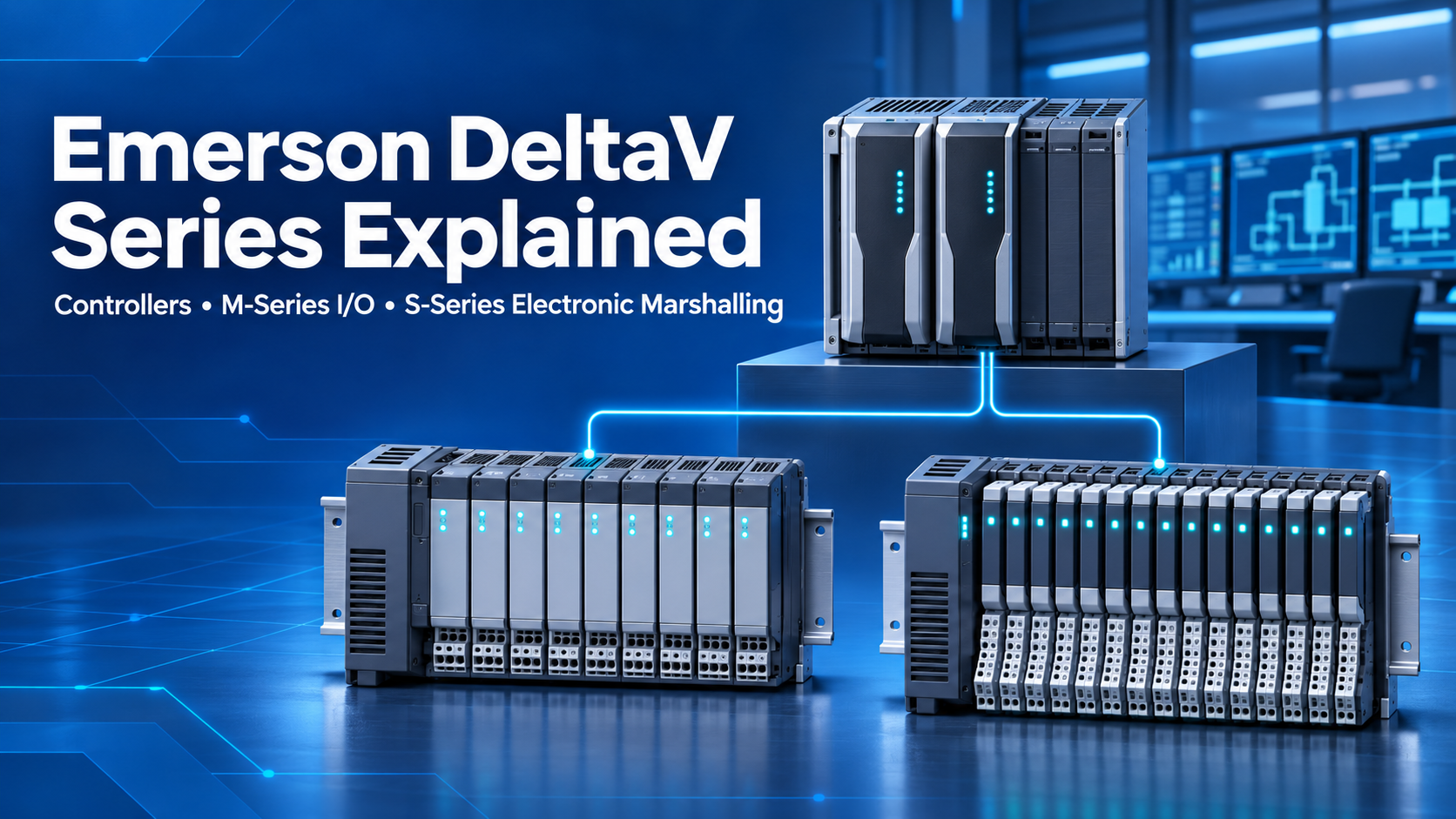
Emerson DeltaV is a scalable distributed control system used in process industries where dependable control, flexible I/O and clear lifecycle planning are essential. Understanding the relationship between controllers, M-Series traditional I/O and S-Series Electronic Marshalling helps maintenance and engineering teams select the correct replacement hardware and plan expansions with fewer surprises.
DeltaV combines controller execution, field I/O, engineering tools, operator interfaces and system networking in one automation environment. The controller executes control strategies and exchanges data with the I/O subsystem. The I/O hardware converts field signals from transmitters, switches, valves and analyzers into data that the controller can use, while output modules send commands back to field devices.
A plant may use M-Series traditional I/O, S-Series traditional I/O, Electronic Marshalling with CHARMs, wireless I/O or a combination of these approaches. The correct hardware choice depends on the installed DeltaV version, controller type, carrier, terminal block, signal type, redundancy requirement, certification and field wiring design.
DeltaV controllers provide communication and control between field devices and other nodes on the control network. Controller selection should be based on the control strategy size, execution requirements, installed system generation, I/O architecture and redundancy plan rather than on appearance alone.
A practical controller for many M-Series installations. It supports automatic I/O detection and can connect to Electronic Marshalling in supported DeltaV releases, making it useful for selected expansion and modernization projects.
A higher-capacity M-Series controller option for demanding control strategies. Exact capacity, software support and redundancy requirements must be checked against the installed DeltaV release.
Designed for scalable applications from standalone skids to integrated DeltaV systems. It offers native Ethernet connectivity, flexible I/O choices and 1:1 redundancy options for suitable configurations.
Installed-base reminder: plants may also operate MD Plus and other earlier controller generations. Never replace a controller without confirming the exact part number, hardware revision, DeltaV software version, licensing, redundancy arrangement and backup status.
M-Series traditional I/O uses modular carriers, I/O cards and matching terminal blocks. The architecture supports common analog and discrete signals as well as thermocouple, RTD, serial, FOUNDATION Fieldbus and other interface types. Its keyed hardware helps prevent an incompatible I/O card from being installed on the wrong terminal block.
Traditional I/O remains valuable for operating plants because it follows a familiar channel-based cabinet design and can work with existing field wiring. Modules can be added in groups appropriate to the selected interface, allowing the system to grow without replacing the entire I/O subsystem.
Electronic Marshalling changes the traditional relationship between field wiring and controller assignment. Each field signal is terminated through a CHARacterization Module, commonly called a CHARM. The CHARM defines the individual channel type, while the CHARM I/O Card, or CIOC, connects groups of channels to the DeltaV control network.
Because channel assignment is completed in software, a signal can be electronically marshalled to an appropriate controller without conventional cross-wiring. This can reduce marshalling cabinets, wiring labor and late-project redesign. A standard CHARM I/O carrier can support up to 96 individually defined channels, subject to the selected hardware and system release.
Typical CHARM types include 4–20 mA analog input and output, 0–10 V input, thermocouple, RTD, dry-contact or NAMUR discrete input, high-side discrete output, relay contact output and isolated signal options. The exact CHARM, baseplate, CIOC generation, redundancy design and certification must be verified for each project.
| Design Point | M-Series Traditional I/O | S-Series Electronic Marshalling |
|---|---|---|
| Signal assignment | Based on fixed card and terminal-block channels | Channel type defined by individual CHARM and assigned in software |
| Marshalling | Conventional cabinet and cross-wiring approach | Reduces or eliminates conventional cross-wiring |
| Late changes | May require card, terminal and wiring changes | Often handled by changing the CHARM and software assignment |
| Best fit | Existing cabinets, established wiring and legacy expansion | Flexible projects, distributed I/O and reduced cabinet wiring |
At the field level, transmitters, switches, analyzers and final control elements connect to traditional I/O cards or CHARMs. The I/O subsystem passes conditioned signal data to the controller over the appropriate local bus or control network. The controller executes control modules, sequences and interlocks, then returns output commands through the I/O layer.
A mixed architecture can be practical during modernization: existing M-Series I/O may remain in service while Electronic Marshalling is introduced for new units or plant expansions. This approach must be engineered around supported DeltaV versions, controller capacity, network design and lifecycle objectives.
Use the full nameplate and installed-system information when requesting a quotation. Availability, condition and compatibility are confirmed individually.
| Model / Family | Hardware Type | Key Check Before Ordering |
|---|---|---|
| MQ Controller | M-Series controller | DeltaV release, memory, I/O and redundancy |
| MX Controller | High-capacity controller | Controller loading, software support and partner configuration |
| PK Controller | Scalable standalone or integrated controller | Capacity class, Ethernet protocols and redundancy |
| KJ2003X1-BA2 / 12P2093X112 | MD Plus controller family | Full suffix, revision and installed software version |
| KJ3222X1-BA1 | 8-channel 4–20 mA HART analog input | Terminal block, redundancy and 12P number |
| KJ3202X1-BA1 / 12P2536X042 | 8-channel 24 VDC high-side discrete output | Field power, load type and terminal block |
| KJ3203X1-BA1 / 12P3270X022 | 32-channel 24 VDC dry-contact input | Channel wiring, carrier and hardware revision |
| KJ3242X1-BA1 / 12P2471X042 | FOUNDATION Fieldbus H1 interface card | DeltaV version, segment power and termination |
| CIOC / CIOC2 | CHARM I/O Card | Generation, carrier, network media and redundancy |
| AI 4–20 mA HART CHARM | Electronic Marshalling analog input | Two-wire/four-wire device and hazardous-area approval |
| DI 24 VDC CHARM | Electronic Marshalling discrete input | Contact type, voltage and baseplate |
| DO High-Side CHARM | Electronic Marshalling discrete output | Load current, protection and field power |
Before requesting DeltaV hardware, record the following information:
Engineering note: compatibility, installation, configuration and safety decisions should be reviewed by qualified personnel using the current manufacturer documentation and the site’s approved procedures.
SupplyPLCs supports a wide range of industrial automation components. Send the complete model number, quantity and destination country so our team can confirm availability, condition and delivery details.
| Model | Model | Model |
|---|---|---|
| 6GK7243-1JX30-0XE0 | 6ES7648-6CA05-0YX0 | 6ES7231-4HD30-0XB0 |
| 6ES5460-4UA13 | 6ES7658-1GX08-2YT7 | 6ES7650-1AL11-6XX0 |
| 6GK5108-0BA00-2AA3 | 6SL3255-0AA00-4BA1 | 6SL3243-6BB30-1HA3 |
| 6ES7221-1BF32-0XB0 | 6ES7431-1KF10-0AB0 | 6ES7331-7NF00-0AB0 |
| 6ES7421-7BH01-0AB0 | 6GK5208-0BA00-2AB2 | 6ES7153-2BA02-0XB0 |
| GE IC660TSD021L | BZMD1-A125 | HDL-MD0602.432 |
| RMP-121D | PS1210 P 70-778-01 | SB-DIM46c2A-DN |
| 15B10964G1 Rev:11 | MS-RA770 | PSM24-12B |
| VFI2 | OM56BHONA | LSS 96K-1070-43 LEUZE 50025254 |
| 995200PEME3 | ABB LS40P13B11 | SFC901A GLL1177 |
| S-T0 | ABB 1SAP176000R0080 CM5640-2ETH | GMP201-C |
| ABB AT/S 4.16.5 | S3-SN-R | PRT-PSU-DIN-8A |
| TM171AETH | PFJ-T082U FA-1J | ESW205-T |
| SB-DIM2c6A-DN | 1609C39G-01 | S520-TH-GSM |
| IZA 2120-HZ | AC2458 M12 2DI-Y 2DO | A56D |
| MP751 416751G | RJ45 CPAC-4-1C-LV:1.3 | ABB PM573-ETH 1SAP130300R0271 |
| 150-C30NBR | DT-F9L5 | CX-100-1-XP |
| EMD-FL-V-300 | SCMD2 | 73091C |
| GE PLE2ESBG01 | MERTEN 647593 | DTD-5233 |
| EY-IO571F001 | GX100MG | T15HD 60-798-02 |
Send the complete nameplate photo, part number, hardware revision, quantity, required condition and destination. We will confirm stock, product photos, compatibility information and delivery details before quotation.
Email: [email protected]
WhatsApp: +86 18159889985
DeltaV and related product names are trademarks of their respective owners and are used for identification and informational purposes only. SupplyPLCs is not an authorized distributor unless otherwise stated.
 EN