 EN
EN

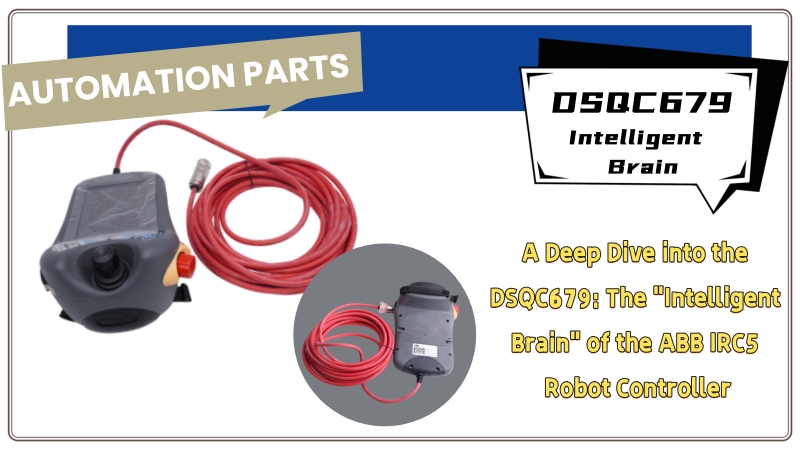
Against the backdrop of the global manufacturing industry's accelerated shift towards intelligent and digital transformation, industrial robot control systems are becoming one of the core infrastructures of modern factories. As an industry leader, ABB's IRC5 robot control platform, with its high stability and strong scalability, is widely used in automotive manufacturing, electronic assembly, metal processing, and logistics automation. Within this system, the DSQC679 module, as a key control unit, is figuratively referred to in the industry as the "intelligent brain," undertaking the core computational and coordination tasks of the entire robot system.
Technical Background of the IRC5 Control System
The IRC5 is ABB's fifth-generation industrial robot controller, whose design emphasizes high real-time performance, high precision, and modular scalability. Compared to earlier control systems, the IRC5 represents a significant upgrade in its computing architecture, highly integrating motion control, path planning, communication management, and safety control, enabling robots to operate stably in complex industrial environments.
In this system, the DSQC679 is not just an ordinary functional module, but a crucial hardware unit undertaking core real-time control and data processing tasks. It acts as the "nerve center" of the robot system, connecting upper-level commands with lower-level actuators, enabling the robot to achieve high-speed, continuous, and precise motion control.
Core Functions and Working Mechanism of the DSQC679
During the operation of an industrial robot, every movement requires a complex computational chain: from path planning and trajectory interpolation to servo control and feedback correction, all processes must be completed in a very short time. The DSQC679 is a key node in this real-time control chain.
First, it is responsible for multi-axis motion coordination control. Industrial robots typically have six or more degrees of freedom, each requiring precise synchronization. The DSQC679, through its high-speed computing power, achieves dynamic balance control between multiple axes, ensuring the robot maintains trajectory stability even at high speeds.
Second, it undertakes real-time data processing and feedback adjustment functions. During operation, the robot continuously receives data from encoders, torque sensors, and external vision systems. The DSQC679 analyzes this data in real time and dynamically corrects deviations, thereby improving motion accuracy and repeatability.
Furthermore, this module possesses system task scheduling capabilities, enabling the rational allocation of computing resources in a multi-task parallel environment. For example, in mixed welding and material handling operations, it can coordinate the execution sequence of different processes, avoiding system conflicts and improving overall production efficiency.
Industrial-Grade Reliability and Performance Advantages
In industrial settings, robot control systems must not only pursue high performance but also possess extremely high stability and anti-interference capabilities. The DSQC679 adopts an industrial-grade hardware design, capable of continuous operation in complex environments such as high temperatures, vibrations, and electromagnetic interference.
Simultaneously, its internal structure is highly optimized to support real-time control loops with millisecond-level or even lower latency. This high-speed response capability allows the robot to maintain stable operation in high-speed production lines, avoiding trajectory deviations or inaccurate movements caused by latency.
Furthermore, the DSQC679 has excellent system architecture scalability and is compatible with various industrial communication protocols, including fieldbus and industrial Ethernet protocols, thereby achieving seamless integration with PLC systems, vision inspection systems, and MES production management systems.
A Key Driver of Smart Manufacturing
With the development of Industry 4.0, robots are no longer merely mechanical devices executing preset actions, but are gradually evolving into intelligent nodes with perception, judgment, and adaptive capabilities. In this transformation, high-performance control modules, represented by the DSQC679, play a fundamental role.
In flexible manufacturing systems, production tasks often need to be rapidly adjusted based on order changes. The DSQC679 can dynamically adjust the robot's path and movement rhythm based on real-time production data, giving the production line greater adaptability and flexibility.
In the automotive manufacturing industry, for example, welding and painting processes require extremely high trajectory accuracy. The DSQC679, through high-frequency control and dynamic error correction mechanisms, enables robots to maintain consistent processing quality on complex curved surfaces, thereby improving product consistency.
From Control Unit to Intelligent Node
The current trend in industrial control technology is shifting from "centralized control" to "distributed intelligence." As the core control module in the IRC5 system, the DSQC679 is no longer just a hardware unit performing computational tasks, but is gradually becoming an important node connecting industrial data flows.
In the future, with the integration of edge computing and artificial intelligence technologies, these control modules are expected to further enhance their autonomous decision-making capabilities. For example, they can optimize motion paths through machine learning algorithms or predict equipment wear and tear through historical data analysis, thus enabling proactive maintenance.
This shift from "passive execution" to "proactive optimization" will significantly improve the intelligence level of industrial robots and drive the entire manufacturing system towards higher efficiency and lower energy consumption.
Future Development Trends
The industry generally believes that the next generation of robot control systems will place greater emphasis on the integration of computing power and intelligent algorithms. Traditional real-time control modules, represented by the DSQC679, will gradually collaborate with AI inference units, digital twin systems, and cloud scheduling platforms to form a more complete intelligent manufacturing ecosystem.
In this process, the controller will no longer be merely a "computing core" within the equipment, but will become a crucial bridge connecting the physical world and the digital factory, achieving comprehensive visualization and intelligent optimization of the production process.
Conclusion
As an important component of the ABB IRC5 control system, the DSQC679 plays an irreplaceable role in modern robot control systems due to its powerful real-time computing capabilities and stable industrial performance. It not only supports the realization of high-precision industrial automation but also represents a crucial technological path for the intelligent upgrading of the manufacturing industry.
In today's global manufacturing landscape, where efficiency and flexibility are constantly being pursued, these core control modules are continuously driving the evolution of industrial robots from "automation tools" to "intelligent production units," becoming an indispensable key force in future smart factories.
If you have any questions about the product, please contact us.
Sales manager:Jim Pei
Wechat: ZXH18020776782
Phone/WhatsApp:+86 18020776782