 EN

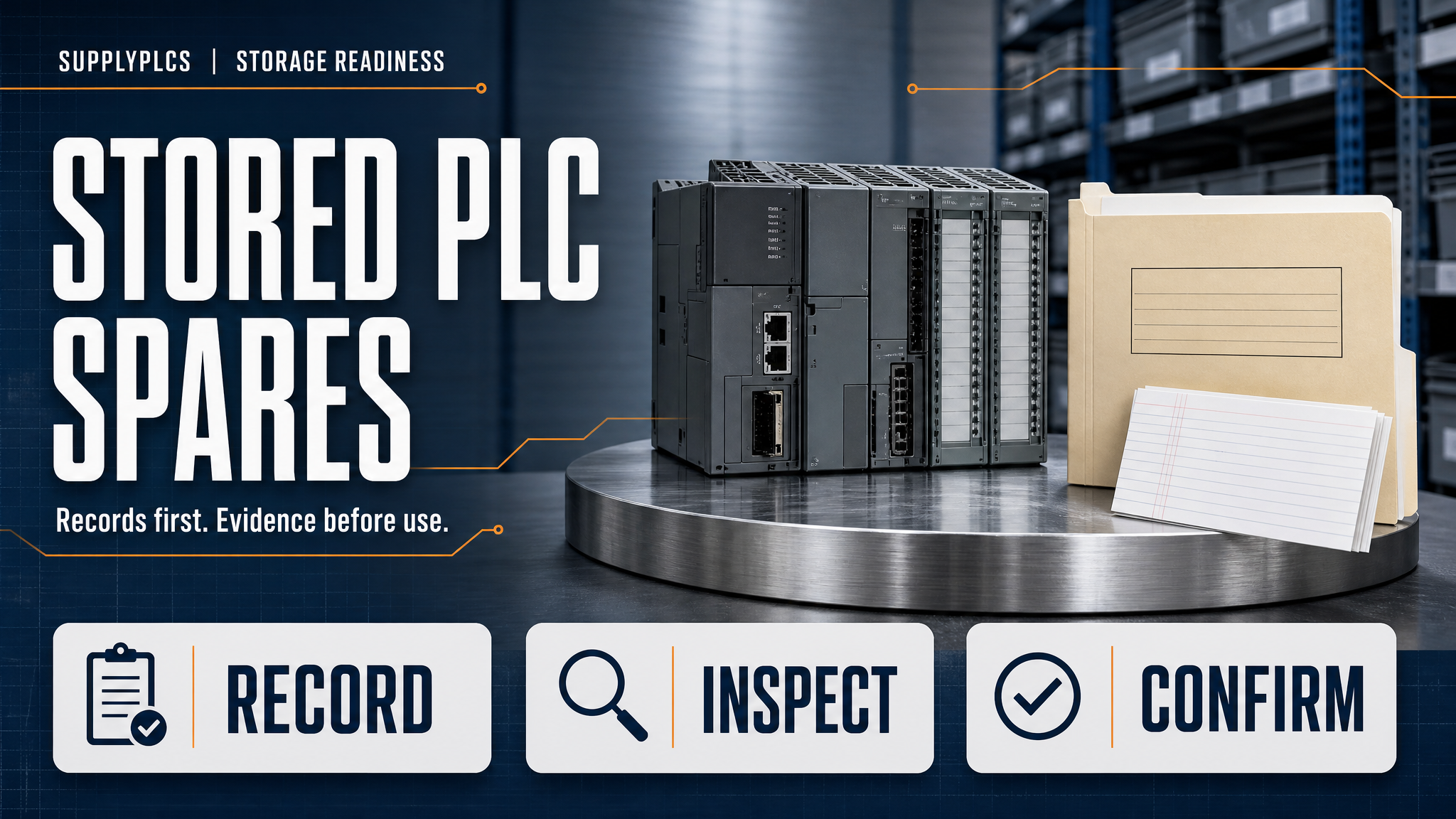
A spare PLC module that has sat in a storeroom for four years is not automatically a usable spare. Between receipt and the day an engineer carries it to a cabinet, the part passes through handling, transport, humidity cycles, staff changes and at least one stocktake. Each of those events leaves evidence, and that evidence separates a part you can plan around from a part you are gambling with. A stored PLC spare parts condition inspection is therefore less about wiping dust off a housing and more about reconstructing a history that a maintenance planner can defend at two in the morning.
This guide covers the records worth keeping, the packaging and physical checks that actually change a decision, and the manual-based steps a technician can complete without energizing anything.
Why Records Outrank Impressions in a Storeroom
Most storeroom decisions rest on impressions. The carton looks clean, the label is legible, the module feels solid, the shelf is dry. When a spare fails inside a shutdown window, nobody asks afterwards whether the box looked clean. They ask what was known about the part before installation, who recorded it, and when.
A stored PLC spare parts condition inspection creates value only when it creates a record. That record should let a second person, months later, reach the same conclusion about the same part without repeating the physical work. The standard is stricter than it sounds: it forces the inspector to separate what was observed, what was reported by somebody else, and what was assumed.
Keep those categories apart on every stored PLC spare parts condition inspection sheet. Observed facts are photographs, label readings, measured settings and packaging states. Reported facts come from a supplier, a previous owner or a colleague, and each should carry the name of its source. Assumptions are everything else, and an assumption written down stays visible, while one copied twice becomes folklore that outlives the person who made it.
The Record Set to Assemble Before Power-Up
Build the stored PLC spare parts condition inspection file while the part is still shelf stock, not during the emergency that consumes it. A workable minimum set for any stored module includes:
- Full order number, hardware revision and serial or lot marking exactly as printed on the rating label.
- Date of receipt and the receiving note, including who performed it and what they examined.
- Supplier documentation: quotation reference, the condition statement as given, and any inspection statement the supplier provided, attributed to that supplier rather than to your own site.
- Photographs taken at receipt: label, front face, connectors, both sides, and interior packaging.
- Storage location history, listing every move between stores, cabinets, buildings or containers.
- Environmental notes for the storage area, such as humidity excursions or known water ingress.
- Firmware, memory or configuration details where that part type carries them.
- Removal record for anything taken out of service, covering the machine, the reason for removal and the condition at removal.
The difference between a part bought as a spare and a part pulled from a machine matters enormously, and the file should never blur it. A removed part has a real failure history and often an unresolved fault. If the removal record does not say why the part came out, treat it as unverified no matter how carefully it has been packed since.
Catalogue photographs are useful for orientation and useless as evidence. They show what a product family looks like, not what sits inside your carton. Any stored PLC spare parts condition inspection built on catalogue images has documented nothing, and the file will fail the first time somebody needs to know whether the unit in hand matches the unit on order.

Modules in the GE 90-30 Series PLC family are a common example of long-held stock, and a stored PLC spare parts condition inspection follows the same logic for any comparable module.
Packaging and Physical Condition
Packaging is the first physical evidence available in a stored PLC spare parts condition inspection, and the easiest to destroy through careless handling. Assess it before opening anything, and photograph it in place on the shelf.
Look for crushed corners, water staining, delamination of cardboard, rust on staples and the state of any desiccant. Note whether the module sits in an antistatic bag, whether that bag is still sealed, and whether the original inner foam or moulded insert is present. Inner packaging is evidence of how the part has been supported. A missing insert means the module may have been loose in a carton through several relocations.
Once opened, work on a clean grounded surface and handle the module by its edges. Photograph before cleaning, because cleaning erases dust patterns, and dust patterns carry information about airflow, liquid contact and how long the part sat exposed.
Physical checks that belong in the record:
- Housing distortion, cracks, or signs of force applied to a connector.
- Corrosion on pins, terminals, screw heads or the backplane connector.
- Bent pins, damaged keying or missing connector hardware.
- Burn marks, discoloration or residue on the board and around power components.
- Switches and jumpers found in positions that differ from the documented setting.
- Missing covers, labels, memory devices, fuses or retaining clips.
- Date codes on capacitors and other marked components, transcribed as read rather than interpreted.
Do not clean corrosion away before photographing it, and do not reseat a memory device to see whether the part looks better. Every intervention changes the object being assessed and quietly invalidates the earlier photographs. A stored PLC spare parts condition inspection records the part as found, not as tidied.
Storage History Questions That Change Decisions
Storage history is where most hidden risk lives, and a stored PLC spare parts condition inspection usually recovers it through interviews rather than instruments. Ask directly, and write the answers down with names and dates.
Has the store ever exceeded the humidity threshold the site sets for electronics? Has the roof leaked, or has a cabinet stood beneath a condensate line? Was the part kept in an unconditioned container, and for how long? Was it moved during a renovation, and by whom? Was it issued to a job and later returned, and what happened while it was out?
A returned part deserves particular caution. Issue-and-return cycles frequently end with a module that was installed, energized briefly, removed for an unrelated reason and put back on the shelf without a note. If the return paperwork is blank, that part needs a stored PLC spare parts condition inspection at the highest level of scrutiny the site can offer, not an immediate installation on a critical line.
Manual-Based Checks a Technician Can Perform Without Energizing
The safest steps in a stored PLC spare parts condition inspection happen with the module unpowered and compared against the manufacturer documentation for that exact order number. The manual is the only authority in the room; a search result is not.
Verify the order number against the ordering data in the manual. Confirm that the revision printed on the label falls inside the revisions the manual describes, and note any addendum it references. Confirm module position, connector types and required clearances against the rack documentation for the destination cabinet.
Read the switch and jumper options from the manual and compare them with the settings recorded during inspection. If they differ, record the difference instead of correcting it. The right setting depends on the destination machine, which may not be the machine the part came from, and quietly fixing a jumper destroys the only evidence of how the part was configured when it left service.
Check memory devices and any configuration media against the part numbers the manual specifies. A module carrying the wrong memory device is not the article that was ordered, even when the housing label matches and the paperwork says otherwise.
Confirm the environmental limits stated in the manual and compare them with the conditions the storage area actually experienced. A part stored outside those limits is not automatically unusable, but the deviation belongs in the record and in the decision that follows.
Finish by writing down what the manual does not answer. Manuals describe product families; they never certify an individual unit and rarely explain how a stored unit returns to service after long dormancy. That gap is where assumptions enter. A stored PLC spare parts condition inspection should close with an explicit list of what remains unverified and who will resolve each item.
A Storeroom Checklist
Run this stored PLC spare parts condition inspection sequence for every stored module and sign each line, so the record shows who asserted what.
- Identity confirmed: order number, revision and serial or lot marking photographed and transcribed.
- Provenance recorded: supplier, invoice, receipt date, or a removal record with machine reference.
- Condition statement captured verbatim, with the source named.
- Packaging assessed before opening, including desiccant state and inner supports.
- Exterior photographed on all faces before cleaning.
- Connector and pin condition examined under good light, with magnification where available.
- Corrosion, heat damage and contamination recorded with their location.
- Switch, jumper and memory device settings recorded as found.
- Storage location history interviewed and written down with dates.
- Manual comparison completed for ordering data, settings and environmental limits.
- Outstanding unknowns listed, each with an owner.
- Decision recorded: fit for intended duty, fit only for non-critical duty, hold for engineering review, or reject.
The final line is the one most often skipped and the one that matters most. A stored PLC spare parts condition inspection that ends with observations but no decision simply relocates the problem to whoever opens the cabinet next.
Anonymous Scenario Example
Illustrative anonymous scenario, not a Supplyplcs customer project.
In October 2023, at an industrial maintenance storeroom in Bangkok, Thailand, a planner requested a stored analogue input module for a packaging line that had lost one channel. The module had been received three years earlier and had moved twice, including one issue to a project later cancelled and returned unopened.
The storeroom held a receiving photograph but no return note. The outer carton was intact, yet the antistatic bag had been resealed with tape that did not match the original closure, and the moulded insert was missing. Under light, two backplane pins carried a dull film consistent with humid storage, and the date code on the bag label placed the repacking after the original receipt date.
The team stopped short of installation. A stored PLC spare parts condition inspection was completed against the module manual, switch settings were recorded as found and compared with the destination rack drawing, and the unknowns were listed plainly: who resealed the bag, whether the module had ever been energized during the cancelled project, and whether the film on the pins was superficial or had reached the plating.
The line restarted on a module with an unbroken paper trail, and the questioned unit went to engineering review instead of back into general stock. The cost of that decision was a one-shift delay. The alternative was a second failure during a running campaign, with a stored PLC spare parts condition inspection file that could not explain the first one.
Where Visual Assessment Must Stop
A stored PLC spare parts condition inspection cannot establish that a module will function, that its memory content is intact, that its outputs switch within specification, or that isolation still holds. Those are functional properties, and confirming them requires equipment and procedures outside the scope of a storeroom check. Careful examination reduces uncertainty without eliminating it.
Be equally careful with the words used in internal records. Inspected should never stand where visually examined is meant. Tested should never appear unless a test was performed, by a named party, using a described method, with a result attached to the file. Suppliers may describe condition in their own vocabulary, and the honest approach is to quote their wording with attribution rather than translate it into site language that implies more than they said.
Where the intended duty is safety-related, or where a failure could release energy, move material unexpectedly or defeat an interlock, the decision belongs to engineering and not to the storeroom. The stored PLC spare parts condition inspection record then has one job: give a qualified person enough evidence to decide quickly and defend the decision later.

Conclusion
Stored spares are an asset only when their history is legible, which is the whole purpose of a stored PLC spare parts condition inspection. The work that makes them legible is unglamorous and repetitive: photographing labels, writing down who moved a carton, reading the manual for the exact order number, and stating clearly what is still unknown. A stored PLC spare parts condition inspection is not a one-off audit but a discipline applied at receipt, at every move, at every issue and at every return.
Teams that keep that discipline learn something useful: the parts they can trust become obvious, and so do the ones that should never have been kept. Supplyplcs is an industrial automation spare parts supplier, and buyers assessing long-held stock get better answers when they ask only for what can be supported in writing.
Table of Contents
- Why Records Outrank Impressions in a Storeroom
- The Record Set to Assemble Before Power-Up
- Packaging and Physical Condition
- Storage History Questions That Change Decisions
- Manual-Based Checks a Technician Can Perform Without Energizing
- A Storeroom Checklist
- Anonymous Scenario Example
- Where Visual Assessment Must Stop
- Conclusion