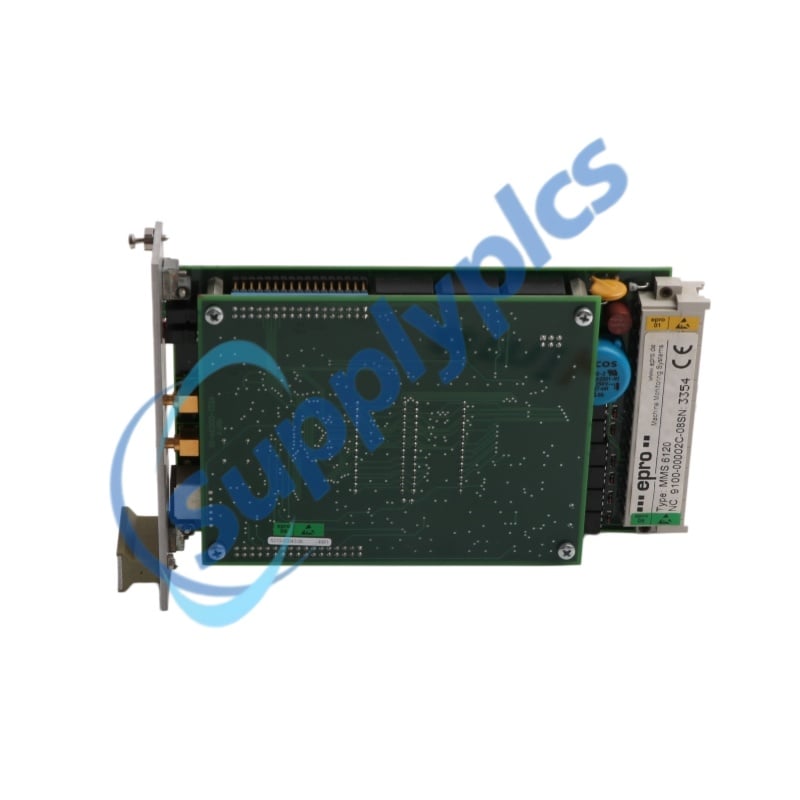
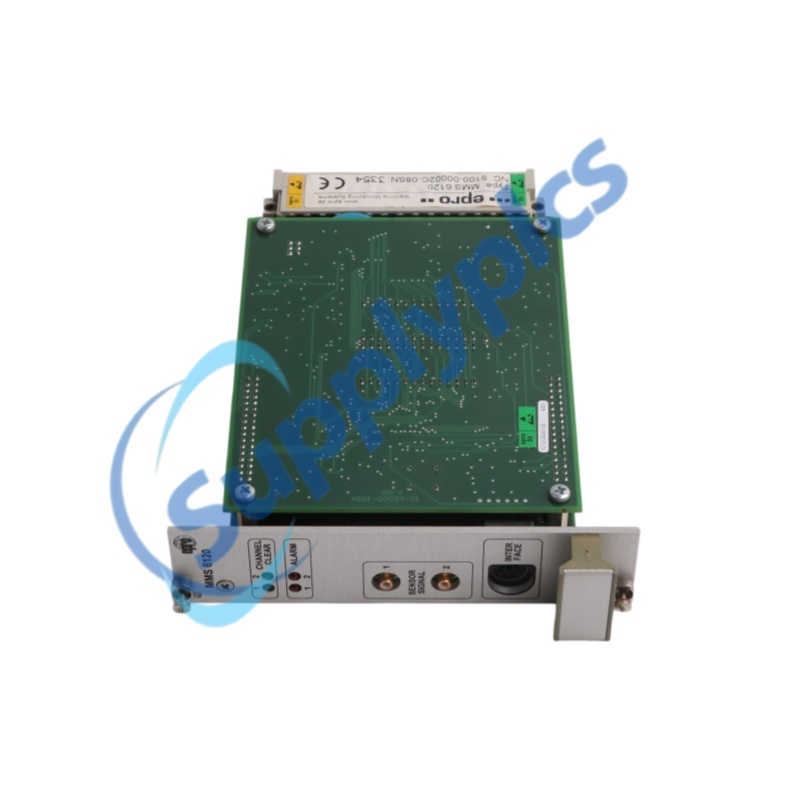
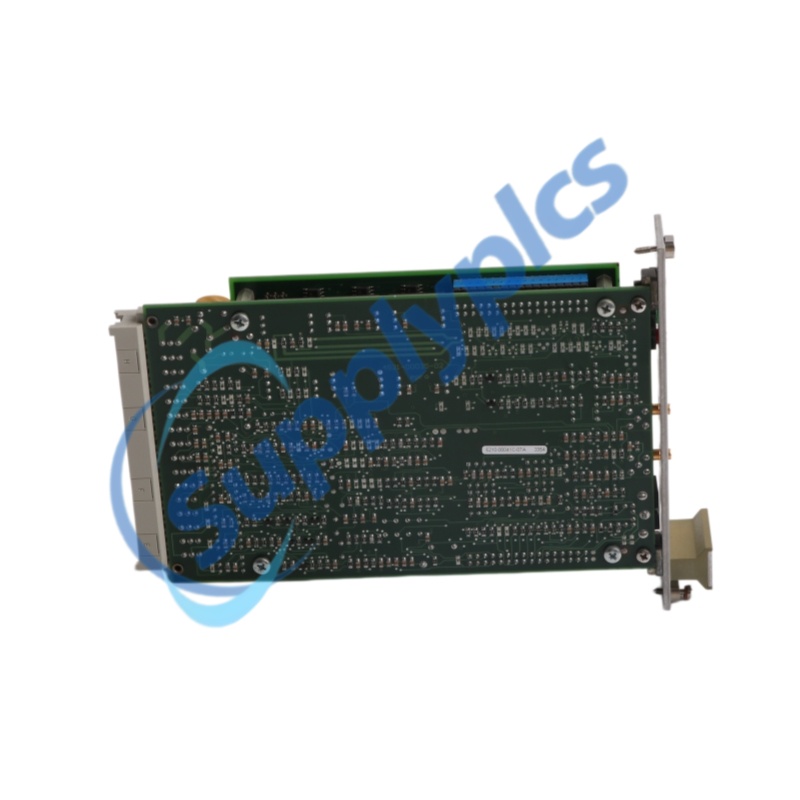
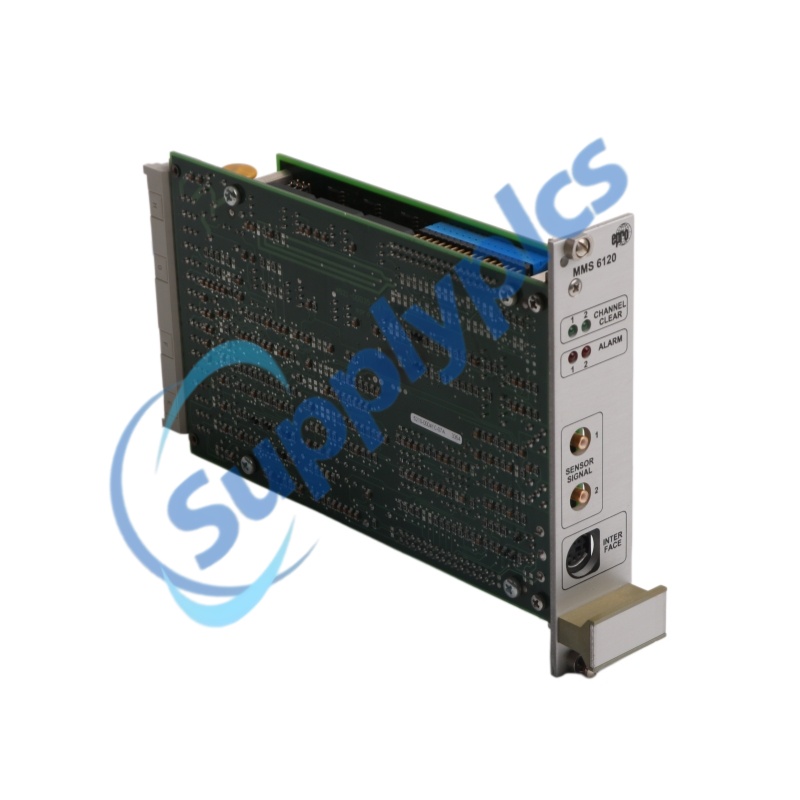
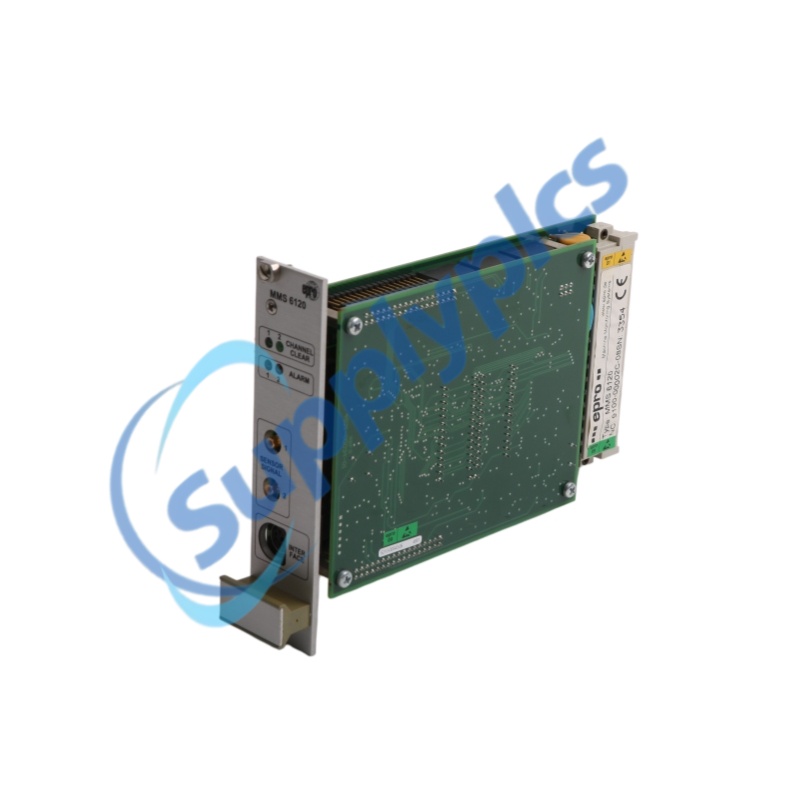
Product Name:Dual Channel Bearing VibrationMonitor
Brand Name: Emerson Epro
Model Number: MMS6120
Country of Origin: USA
Warranty: 12 Months
Whatsapp:+86 18159889985
Email:[email protected]

Brand Name: |
Emerson Epro |
Model Number: |
MMS6120 |
Country of Origin: |
USA |
Packaging Details: |
Original new Factory Sealed |
Delivery Time: |
in stock |
Payment Terms: |
T/T |
|
Sales Manager: |
Stella |
|
Send an email: |
|
|
Contact in Whatsapp: |
|
Parameter |
Specification |
|
Model |
MMS6120 (epro, MMS 6000) |
|
Channels |
2 independent |
|
Sensor Input |
Electrodynamic velocity (PR 9266/…–PR 9268/…); also eddy current/piezo |
|
Frequency Range |
10–1000 Hz (std); 5–1600 Hz (opt) |
|
Measured Values |
V<sub>RMS</sub> (5–100 mm/s), S<sub>op</sub>/S<sub>pp</sub> (±25–±500 µm) |
|
Outputs |
2 × 0/4-20 mA (load <500 Ω), 2 × 0-10 V |
|
Alarms |
4 relays (Alert/Danger per ch), delay 1–6 s |
|
Communication |
RS-232 (front), RS-485 (up to 31 modules) |
|
Power |
18–31.2 V DC (redundant, diode-decoupled), max 6 W |
|
Environment |
0…+65°C, IP00 (module), IP21 (front) |
|
Order No. |
9100-00002 / Accessories: MMS 6910 W |
|
Dimensions |
3x19x12.7cm |
|
Weight |
0.3kg |
The MMS6120 is a dual‑channel bearing vibration monitor from epro‘s MMS 6000 series, designed for absolute vibration on turbines, compressors, and fans. It accepts PR 9266/… to PR 9268/… velocity sensors and measures V<sub>RMS</sub>, S<sub>op</sub>, or S<sub>pp</sub> per VDI 2056, ISO 3945. The MMS6120 provides isolated current/voltage outputs, configurable alarms, RS‑232/RS‑485, built‑in order analysis (3 harmonics + phase), redundant power, and hot‑swap capability.
Wide frequency range (5–1600 Hz) covers low‑ and high‑speed machines.
Hot‑swappable design avoids downtime.
True RMS measurement compliant with international standards.
Built‑in order analysis with harmonics and phase angles for fault diagnosis.
Comprehensive self‑diagnostics (sensor/cable, supply, temperature, watchdog).
Redundant power inputs ensure continuous operation.
Multi‑sensor compatibility (velocity, eddy current, piezo).
Dual independent channels, individually configurable.
Selectable measurement modes: V<sub>RMS</sub>, S<sub>op</sub>, S<sub>pp</sub>.
Programmable measuring ranges, units, sensor sensitivity, and filters.
Four alarm relays (Alert/Danger per channel) with delay and hysteresis.
Two isolated 0/4–20 mA and two 0–10 V outputs.
Lifting coil current (0–8 mA) for transducer sag compensation.
Keypulse input for order analysis and phase reference.
RS‑232 for local configuration; RS‑485 for MMS 6850 integration.
Password‑protected access.
Hot‑swappable; redundant power inputs.
The MMS6120 conditions AC signals from electrodynamic velocity sensors mounted on bearings. It computes V<sub>RMS</sub>, S<sub>op</sub>, or S<sub>pp</sub> per standards, using filtering and amplification. An internal microcontroller performs order analysis (up to 3 harmonics and phase angles) using the keypulse input for reference. The processed values are output as isolated 0/4‑20 mA and 0‑10 V signals. Alarm relays trigger when thresholds are exceeded. Continuous self‑diagnostics check sensor wiring, supply voltages, internal temperature, and configuration; a green “Channel Clear” LED indicates normal status. Communication via RS‑232 (local) or RS‑485 (with MMS 6850) enables remote monitoring and diagnostics.
Q1: Which sensors work with the MMS6120?
A1: Electrodynamic velocity sensors (PR 9266…PR 9268) are primary; eddy‑current and piezo sensors are also supported.
Q2: What vibration parameters can it measure?
A2: V<sub>RMS</sub> (velocity), S<sub>op</sub> (zero‑to‑peak displacement), and S<sub>pp</sub> (peak‑to‑peak displacement).
Q3: Can the module be replaced without shutting down the system?
A3: Yes, it is hot‑swappable; redundant power ensures continuous operation.
Q4: What is the lifting coil current for?
A4: It compensates for mechanical sag of vertical‑mounted velocity sensors (0–8 mA adjustable).
Q5: Does it support order analysis?
A5: Yes, it provides up to three selectable harmonics (1/4, 1/2, or 1‑10× speed) and phase angles via RS‑485.
Inquiry Now :[email protected]
 EN
EN