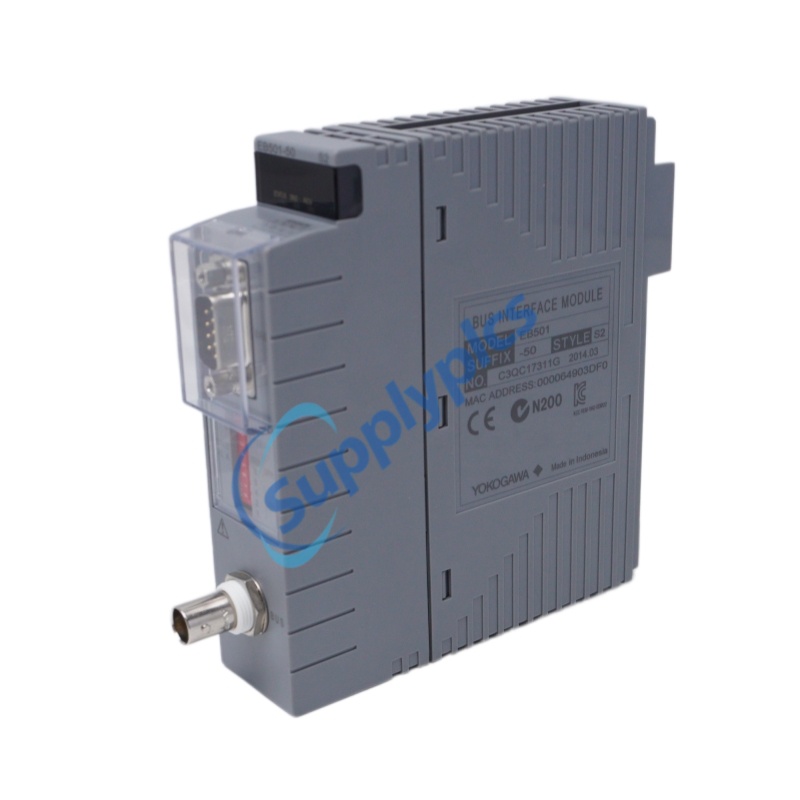
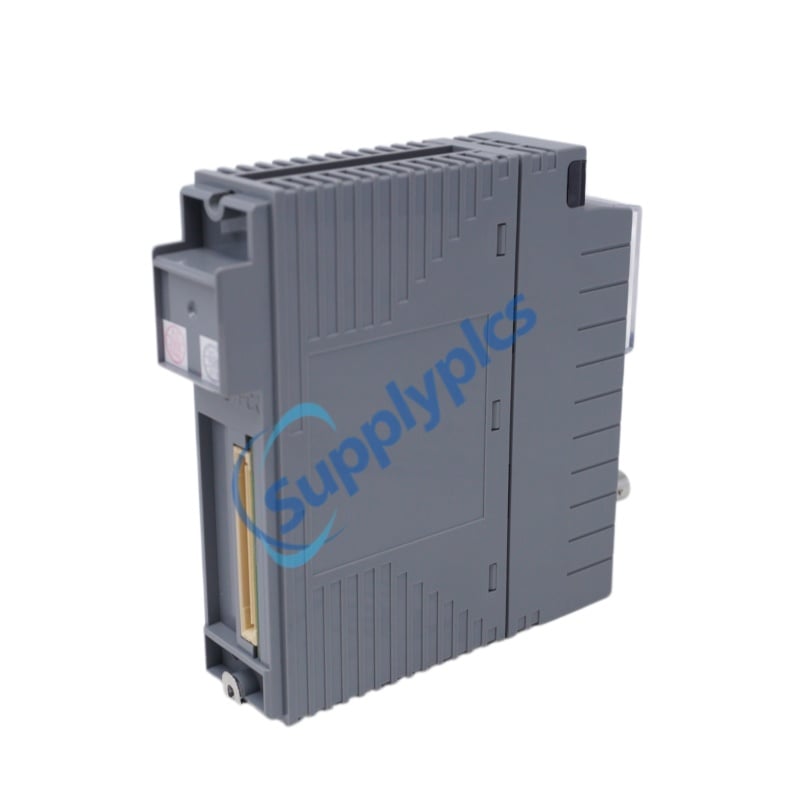
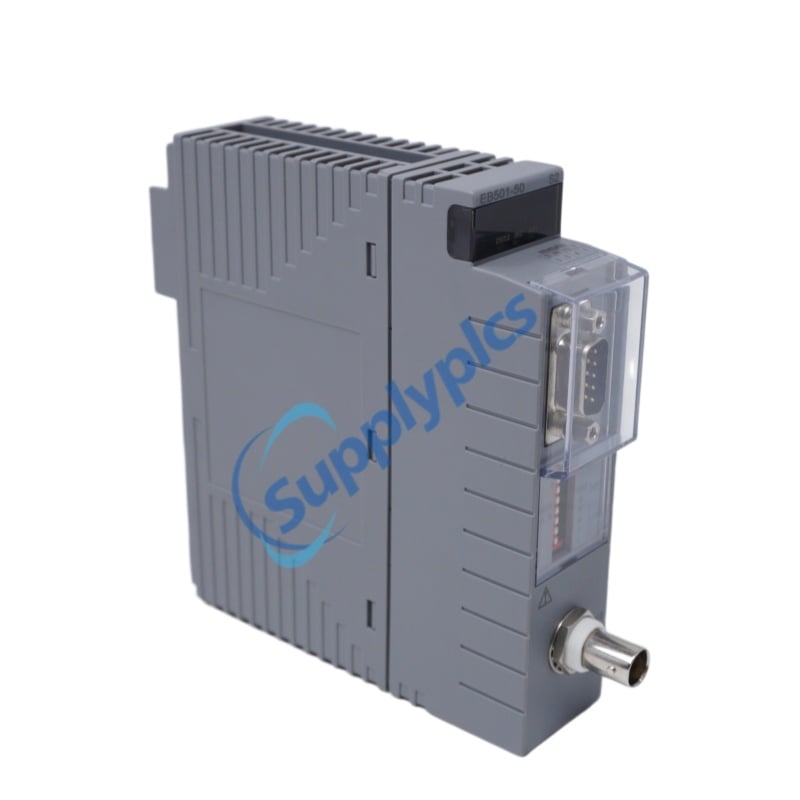
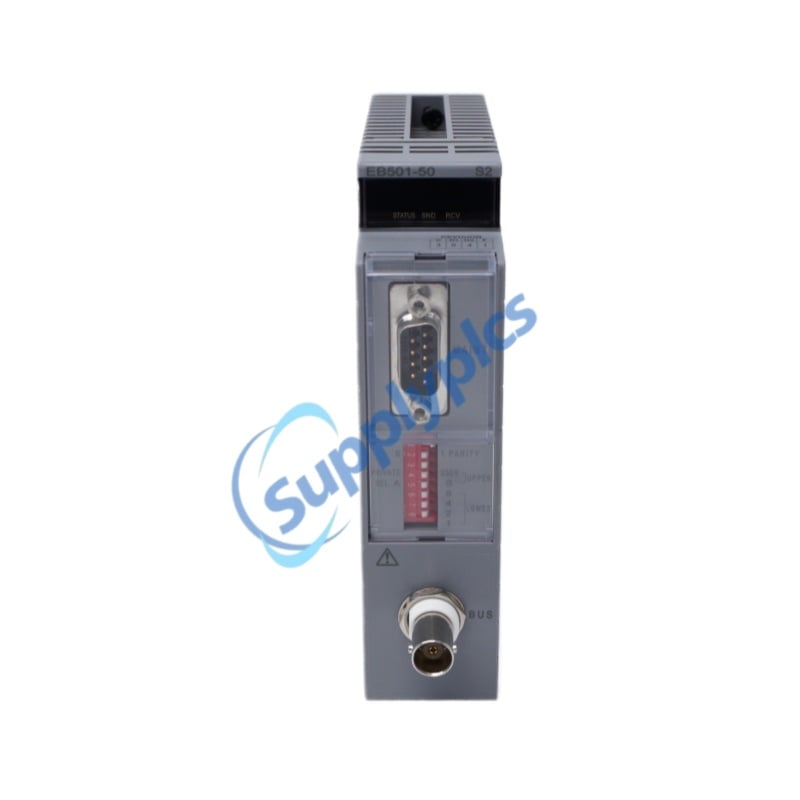
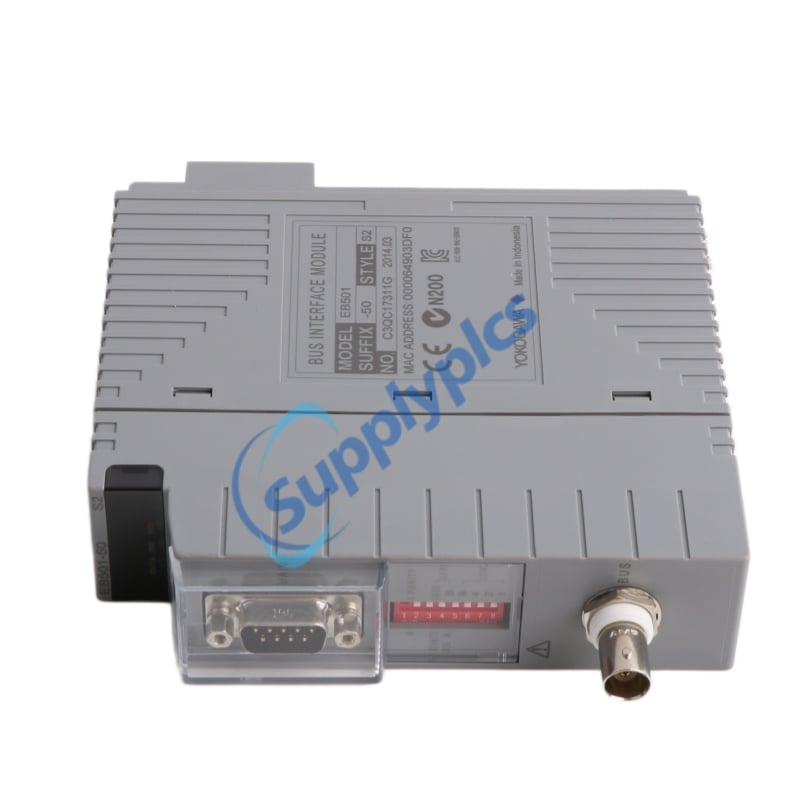
Product Name: Bus Interface Module Supplier
Brand Name: YOKOGAWA
Model Number:EB501-50 S2
Country of Origin:JAPAN
Warranty: 12 Months
Whatsapp:+86 18159889985
Email:[email protected]

Brand Name: |
YOKOGAWA |
Model Number: |
EB501-50 S2 |
Country of Origin: |
JAPAN |
Packaging Details: |
Original new Factory Sealed |
Delivery Time: |
Delivery time in stock |
Payment Terms: |
T/T |
|
Sales Manager: |
Stella |
|
Send an email: |
|
|
Contact in Whatsapp: |
The EB501-50 S2 is an ER Bus Interface Slave Module from Yokogawa, engineered to establish high-speed communication between Field Control Units (FCUs) and remote I/O nodes within CENTUM VP, CENTUM CS 3000, and ProSafe-RS distributed control systems. The EB501-50 S2 operates at 10 Mbps over Yokogawa‘s proprietary ER bus, enabling deterministic data exchange between FIO I/O modules and the controller-side ER Bus master. Supporting dual-redundant configurations and SIL 3 safety certification, the EB501-50 S2 delivers industrial-grade reliability for critical process automation and safety instrumented systems. The “-50” suffix indicates standard type without explosion protection.
SIL 3 Safety Certification – Certified for use in Safety Instrumented Systems (SIS) per IEC 61508 and IEC 61511, making it suitable for emergency shutdown systems (ESD), fire and gas detection, and burner management applications.
Fault-Tolerant Ring Architecture – When deployed in redundant ER bus configurations, the module automatically detects network failures and reroutes communication within 10 milliseconds, maintaining continuous operation during cable breaks or switch failures.
High-Speed Deterministic Communication – Delivers sub-millisecond response times for time-critical control loops, ensuring precise synchronization between distributed field devices and central controllers.
Dual-Redundant Bus Support – Supports redundant transmission paths on the ER bus for enhanced system availability.
Seamless CENTUM Integration – Plug-and-play auto-configuration capabilities eliminate manual network setup—the module automatically discovers its position in the ER bus topology and establishes communication with the system controller upon power-up.
Hybrid DCS-SIS Architectures – Enables integrated control and safety systems where basic process control and safety-critical functions coexist on shared infrastructure while maintaining functional separation required by safety standards.
ER Bus Slave Communication – Provides direct physical and electrical execution of communication between FIO I/O modules and the ER Bus master architecture
10 Mbps Transmission Speed – Facilitates rapid and efficient exchange of control signals and process data between the controller and field devices
BNC Coaxial Connection – Uses coaxial cable (YCB141 or YCB311) terminated with BNC connectors for robust physical layer connectivity
Dual-Redundant Operation – Supports redundant ER bus configurations for high system reliability
SIL 3 Functional Safety – Certified for safety instrumented systems complying with IEC 61508 and IEC 61511 standards
Plug-and-Play Auto-Configuration – Automatic discovery and communication establishment with the system controller upon power-up
Comprehensive LED Diagnostics – Real-time status indicators for power, communication activity, and fault conditions
Wide Temperature Operation – Operates from 0°C to 55°C with cold start capability down to –20°C
G3 Environment Support – Corrosive gas protection when used with applicable node variants
Continuous Hardware Self-Diagnostics – Ongoing health monitoring and communication status reporting
The EB501-50 S2 functions as the slave communication interface within Yokogawa‘s ER (Ethernet Ring) bus architecture, connecting Field Control Units (FCUs) to remote I/O nodes housing various I/O modules.
Bus Communication. The module operates on a ring topology, receiving and forwarding data packets between the ER Bus master (typically located in the FCU) and field devices connected through ER Bus Node Units (ANR10S or ANR10D). Data transfer occurs at 10 Mbps over coaxial cable (YCB141 or YCB311) with BNC connectors.
Redundancy & Fault Tolerance. In dual-redundant configurations, the module supports automatic failover with sub-10 ms recovery time. If a cable break or switch failure occurs on the primary path, communication is automatically rerouted through the secondary path without interrupting process control.
Auto-Discovery & Initialization. Upon power-up, the module automatically discovers its position in the ER bus topology and establishes communication with the system controller. In cold start conditions (powered from –20°C to 0°C storage), the module requires up to 10 minutes warm-up before full operation.
Data Exchange. The module manages the physical and electrical execution of communication between FIO I/O modules and the ER Bus master. It handles internal bus timing, arbitration, and data routing while maintaining separation between field-side signal processing and controller communications.
Safety Integration. When deployed in ProSafe-RS SIS configurations, the module links safety I/O modules monitoring critical process variables (pressure, temperature, level) to safety logic solvers executing protective actions during abnormal operating conditions.
Q1: What is the primary function of the EB501-50 S2?
A1: The EB501-50 S2 serves as an ER Bus Interface Slave Module that connects Field Control Units (FCUs) to remote I/O nodes via Yokogawa‘s proprietary ER bus, enabling 10 Mbps data transmission between FIO I/O modules and the controller-side ER Bus master.
Q2: What do the suffix codes “-50” and “S2” indicate?
A2: The “-50” suffix indicates standard type with no explosion protection. The “S2” suffix denotes a specific hardware revision or configuration variant.
Q3: Does the EB501-50 S2 support redundant communication?
A3: Yes. While the module itself is typically used in a single configuration, the ER bus network it connects to can be configured with redundant transmission paths. The module supports dual-redundant ER bus configurations for enhanced system reliability.
Q4: What type of cable and connector are used with the EB501-50 S2?
A4: The module uses coaxial cable—specifically Yokogawa‘s YCB141 or YCB311—for its physical connection to the ER bus network, terminated with a BNC connector. The maximum transmission distance for a single segment using YCB141 cable is 185 meters.
Q5: Which systems and node units are compatible with the EB501-50 S2?
A5: The EB501-50 S2 is compatible with Yokogawa CENTUM VP, CENTUM CS 3000, and ProSafe-RS systems. It can be installed in ANR10S (Single) and ANR10D (Dual-Redundant) ER Bus Node Units.
Inquiry Now: [email protected]
 EN
EN